Crusader Kings 3 Succession Laws Compared
Updated October 2026: added gender laws, a full how-to-change section, the partition survival playbook, an expanded elective section, and a FAQ. Corrected the High Partition unlock (Heraldry, not Royal Prerogative). Mechanics re-verified October 21, 2026.
CK3 succession laws are the thing that ends more campaigns than any war. You build a great kingdom, your ruler dies, and suddenly your realm is split between your sons like a pizza. Understanding succession laws, and how to work around them, is the difference between a dynasty that grows and one that collapses every generation. This guide compares every CK3 succession law, explains gender laws, shows how to change your law, and gives you the practical tricks that keep your realm together while you wait for Primogeniture.

Source: Paradox Interactive / Crusader Kings III official screenshots Succession planning only matters if you can get a strong dynasty going first, which is why we also recommend the best starting character guide and the renown and prestige guide.
How CK3 succession laws work
Your succession law decides what happens to your titles when your ruler dies, and the fine print matters more than the headline.
First, succession laws come in two flavors. Single-heir laws (Primogeniture, Ultimogeniture, House Seniority) pass everything to one person. Multiple-heir laws (Confederate Partition, Partition, High Partition) split your titles among your eligible children. Your whole early and mid game is spent under a multiple-heir law, which is why this guide spends most of its time there.
Second, there is the realm law and there are per-title laws. Every title you hold follows your realm succession law unless that title has its own special succession attached. If you usurp a title with a special law, you can pay prestige to remove it.
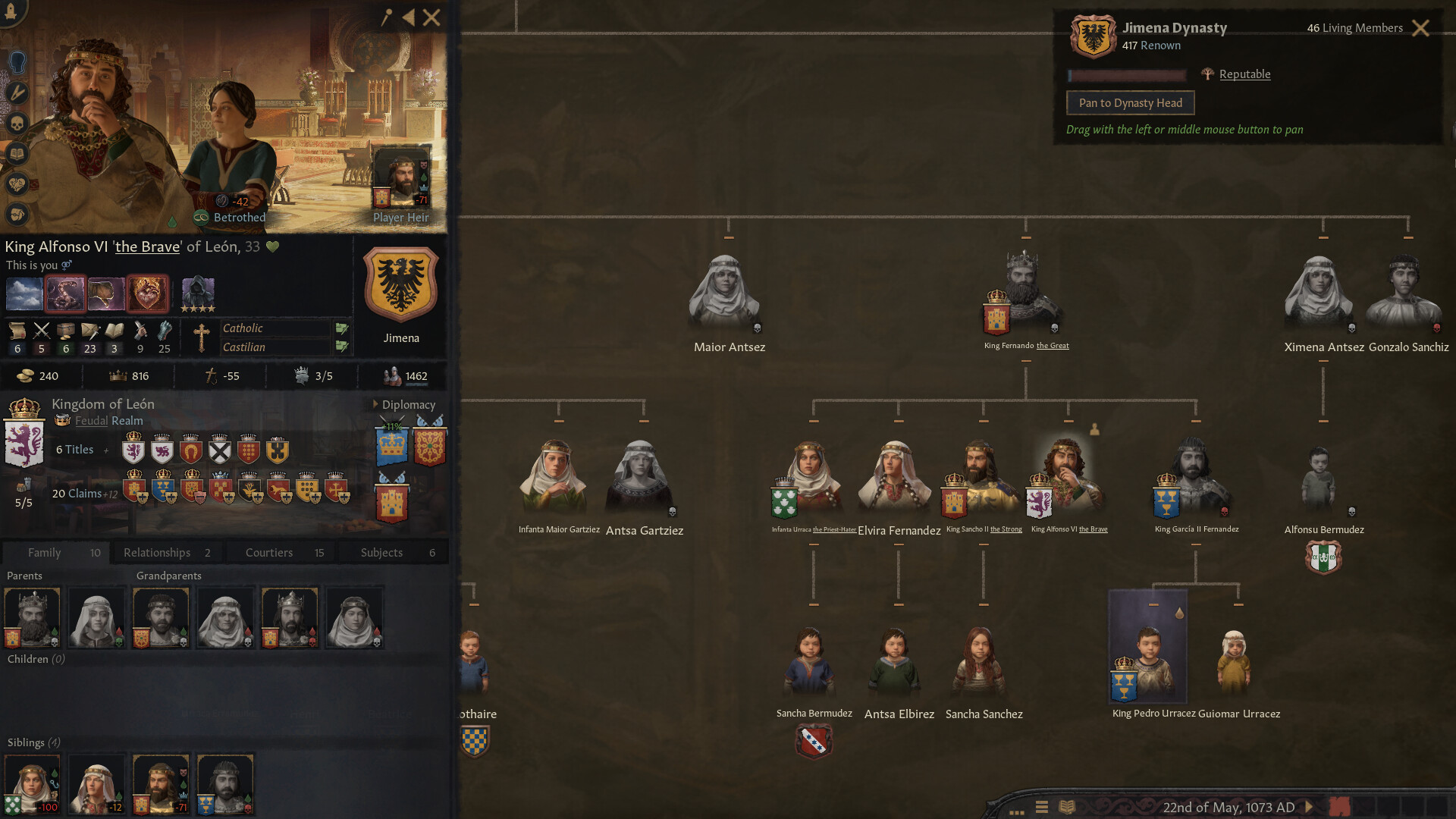
Third, a few guarantees always hold. Your player heir always receives your primary title, your realm capital, and the direct de jure titles tied to it. If one of your children dies before you do, that child’s share passes to their own children. And partition takes your children’s current holdings into account, which is the basis of the most important survival trick in this guide: land your spare heirs before you die, and the game counts those lands as their share.
Source: Paradox Interactive / Crusader Kings III official screenshots
Gender laws
Before any succession law runs, the gender law decides who counts as an eligible heir.
- Male Preference. The default for most of the map. Sons inherit before daughters; daughters only inherit when no eligible son exists.
- Male Only. Only men can inherit. Clean and simple until you have nothing but daughters, at which point it becomes a succession crisis with extra steps.
- Female Only. The mirror image. Useful in specific roleplay or achievement runs, dangerous everywhere else.
- Equal. Sons and daughters inherit on fully equal footing. The catch is that your faith and your culture both have to allow equal gender rights before you can select it.
Most players never touch the gender law and play Male Preference for the whole campaign, which is fine. Just know it exists, because the day you have five brilliant daughters and one mediocre son, you will wish you had checked.
Confederate Partition
This is the default, and it is the one that causes the most pain. Here is how it works:
- Your titles are split equally among your eligible children
- New titles are created automatically to make the split fair. This is the killer. If you are a king with one kingdom title and you have two sons, the game will create a second kingdom title for your second son, splitting your realm in two
- Your primary heir gets your primary title and the best share, but you will lose territory
When it is good: Never, really. It is the starting law and you should be working to get rid of it as soon as possible. Tribal rulers are stuck with it until they reform to a feudal or clan government, which makes the tribal start the hardest succession puzzle in the game.
Partition
Partition is the upgrade from Confederate Partition, unlocked through the Hereditary Rule innovation in the Early Medieval era. It requires a feudal or clan government and at least Limited crown authority. The difference:
- Your titles are still split among your children
- But new titles are NOT created automatically. If you are a king with one kingdom title and two sons, your second son will not get a new kingdom created for him. He will get some of your duchies and counties instead
When it is good: It is a strict upgrade from Confederate Partition. You will still lose some territory, but your realm will not split into multiple kingdoms. And here is the trick that makes Partition genuinely livable: the game only distributes titles you actually hold. Do not create duchies or kingdoms you cannot afford to lose, and there is nothing extra to split.
High Partition
High Partition is the next step up, unlocked through the Heraldry innovation in the High Medieval era (roughly 1050 AD onward). The key difference:
- Your primary heir gets at least half of your titles
- The rest is split among your other children
When it is good: This is where succession starts feeling manageable. Your primary heir keeps the core of your realm, and you only lose the fringes. It is a significant quality-of-life improvement, and for many campaigns it is the law you will actually play most of your game under.
Primogeniture
Primogeniture is the endgame of succession laws. It arrives in the Late Medieval era (around 1200 AD), and it is the one you are working toward:
- Your primary heir gets everything. All titles go to your eldest eligible child
- No more splitting, no more losing territory on succession
When it is good: Always. This is the goal. Once you have Primogeniture, succession stops being a crisis and becomes a non-issue. Two things to manage: your younger children will be unhappy about getting nothing, which costs you prestige and their opinion, and you cannot simply pick a better child as heir. If you want to choose, you need Absolute crown authority so you can designate your heir directly.
Ultimogeniture
Ultimogeniture is the reverse of Primogeniture and arrives in the same Late Medieval era. Your youngest eligible child inherits everything.
When it is good: It is a niche choice with one real argument: a younger heir means a longer reign, and long reigns mean better vassal relations over time. The counterargument is that a child on the throne is a target. Treat it as a deliberate choice for a specific campaign, not a default.
House Seniority
House Seniority makes the oldest member of your house inherit everything. It unlocks through the Heraldry innovation in the High Medieval era, the same innovation as High Partition, and cultures with the Table of Princes tradition can use it from the very start of the game. That makes it the earliest single-heir law most campaigns can reach.
When it is good: It keeps the realm together and it does not care about your children at all, which solves the partition problem early. The price is unpredictability. Your heir could be your uncle, your cousin, or someone you have never looked at. Expect short reigns, since the oldest dynast is rarely young, and short reigns mean the short-reign opinion penalty with your vassals. Use it as a bridge to Primogeniture, not a destination.
Elective laws
Elective laws let your vassals vote on who inherits. The known types include Feudal Elective, Saxon Elective, Scandinavian Elective, and Tanistry, the last one tied to Goidelic and Brythonic cultures.
When they are good: Electives are powerful if you can control the vote. Stack hooks, gifts, and alliances on your electors, get your preferred heir elected, and you bypass the partition problem entirely while keeping a single heir. Some players run elective laws for entire campaigns on purpose. The downside is the obvious one: if you lose control of the vote, a random vassal takes your throne and your campaign takes a very different turn. Only take an elective law when you are already winning the popularity contest.
How to change your succession law
Changing the law is deliberately gated. Expect to spend prestige on the change, and expect your most powerful vassals to have a say. In practice, that means keeping your top vassals happy before you touch the succession tab, because an opposed law change is a faction waiting to happen.
Two milestones to plan around. Reaching Absolute crown authority unlocks the ability to designate your heir directly, which pairs with Primogeniture to let you choose exactly which child gets everything. And remember that special per-title succession laws survive usurpation, so check conquered titles and pay the prestige to normalize them when it matters.
Surviving partition: the practical playbook
Most of your campaign happens under a partition law, so this is the section that actually saves campaigns.
- Check your succession tab regularly. It shows exactly what happens when your ruler dies, title by title. Do not be surprised on death day.
- Hold one title per rank. Never hold two kingdoms as a king or two duchies as a duke unless you are ready to lose one. Under Partition and High Partition the extra same-rank title is what splits your realm.
- Do not create titles you cannot afford to split. Under Partition and High Partition, uncreated titles are never distributed. That duchy you have not created yet is safe by definition.
- Land your spare heirs before you die. Partition counts what your children already hold. A son who already has two duchies is treated as already having his share, which keeps your demesne with your player heir.
- Disinherit problem children. It costs dynasty renown, and the price goes up each time, but removing one heir from the split is often cheaper than losing half your realm.
- Manage your family size deliberately. Fewer eligible children means fewer shares. Celibacy, strategic marriages, and the sadder options all exist for a reason.
- Remember claims. Pressed claims pass to your heirs, so a lost title is not always lost forever. Your children inherit the casus belli to take it back.
The cheapest succession tool is not in the game at all: a plan written down before your ruler dies. I put dedicated succession planner pages into Blood & Crown, a physical journal for medieval strategy gamers, so you can map heir candidates and title splits while there is still time to fix them.
FAQ
What is the best succession law in CK3?
Primogeniture, once you can get it. It is the only law that guarantees zero title loss with zero management. Until the Late Medieval era, High Partition is the realistic best-in-class, and House Seniority is the earliest single-heir bridge.
Can I change the gender law?
Yes, through the same realm laws interface, but Equal in particular is gated behind your faith and culture allowing it. Most campaigns stay on Male Preference and never need to change.
Why am I stuck on Confederate Partition?
Either your culture has not unlocked a better law yet, or you are tribal. Tribal governments cannot change succession at all until they reform to feudal or clan. If you are feudal and stuck, check the innovation requirements: Hereditary Rule for Partition, Heraldry for High Partition.
What is forced partition in CK3?
There is no law literally called that in the interface. Players usually mean one of two things: being stuck splitting titles under a partition law they cannot escape yet (most often the tribal lock-in above), or watching the game create titles under Confederate Partition. Both are covered in the survival playbook above.
Does the By God Alone DLC change succession?
Not the laws in this guide. By God Alone is the religion expansion (playable theocracies, the College of Cardinals, Rites), and it does not replace the realm succession laws above. If you landed here searching for noble family or acclamation succession, those come from Roads to Power instead: administrative realms run on noble families, and their titles pass through Acclamation or Appointment succession rather than partition, so they sit outside the law system in this guide entirely. Our By God Alone breakdown covers what the expansion actually changes.
What should I read next?
If you are new to the game, start with the best starting characters to pick a ruler whose succession you can actually manage. Once your dynasty is rolling, the renown and prestige guide explains the currencies that disinheritance and law changes run on. And if you keep losing track of who inherits what, our guide to keeping track of your dynasty is the companion piece.