EU4 Government Reforms Guide: Best Pick for Every Tier (2026 Update)
Government reforms are EU4’s political tech tree. You bank reform progress over the course of a campaign and spend it tier by tier on permanent bonuses that reshape your economy, your military, and your path to absolutism. Pick well and your nation compounds in power. Pick blindly and you leave some of the strongest modifiers in the game on the table.
One correction to the old version of this guide: there is no single “12 tiers” system. Monarchies have 11 tiers, republics have 13, and theocracies and tribes run their own trees. This update gives you the best pick for every tier of each, plus the actual math behind reform progress. EU4 is a separate game from EU5, so none of this changes with the EU5 1.4 patch.
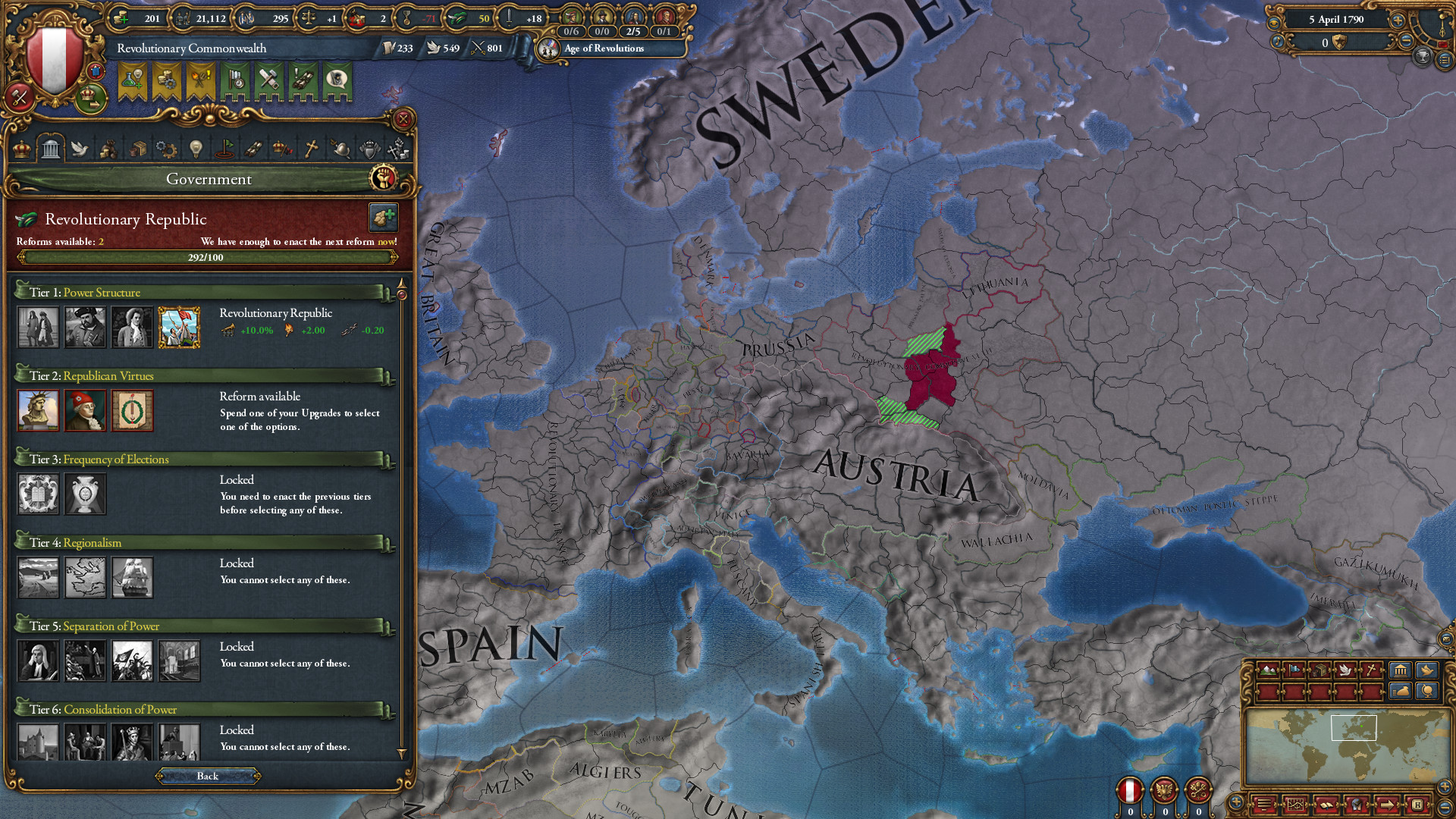
Source: Paradox Interactive / Europa Universalis IV official screenshots
How Reform Progress Actually Works
You start with your tier 1 reform already chosen. Every reform after that costs progress, and the price climbs steeply:
| Tier | Cost | Tier | Cost |
|---|---|---|---|
| T2 | 100 | T8 | 340 |
| T3 | 140 | T9 | 380 |
| T4 | 180 | T10 | 420 |
| T5 | 220 | T11 | 460 |
| T6 | 260 | T12 | 500 (republics) |
| T7 | 300 | T13 | 540 (republics) |
Changed your mind about a pick? Switching to a different reform in a tier you already passed costs a flat 50 progress.
Progress itself grows from a base of +10 per year. The game divides that base by (100% + your average province autonomy), so at 50% average autonomy you grow at roughly two-thirds speed, then multiplies by your growth modifiers. Two practical consequences: conquering huge low-control territories slows your reform clock, and anything that raises crownland, republican tradition, or devotion speeds it up. The wiki lists no cap on stored progress, so you can bank it while waiting for the right tier.
You can also spend progress on Expand Administration: 20 progress for the first level, then 24, 28, and so on (+4 each level), with each level giving +20 governing capacity. The Two Treatises of Government (monarchy T9) and Federal Senate (republic T13) make this free, which is a big deal for wide campaigns.
Reform trees live or die with your estates and crownland, so keep that system healthy while you climb the tiers.
Best Monarchy Reform Pick for Every Tier
Monarchies are what most players run, and their 11 tiers contain the famous absolutism engines. Here is the strongest pick at each tier and why.
Tier 1: Power Structure
Tier 1 is almost always locked to your nation, so there is no universal “best.” The three headline powers, where available, are Tsardom (Russia’s claim and modernization mechanics), Prussian Monarchy (militarization of the state), and Iqta (+5% tax, +33% income from vassals). For a generic monarchy choosing between Feudal Nobility and Autocracy, treat T1 as a placeholder: the real power of this tree sits in the later tiers.
Tier 2: Noble Privileges, pick Curtail Noble Privileges
Curtail Noble Privileges (+15% tax, -10% nobility influence) is the default. The tax is welcome at every stage, and weakening the nobles early makes the absolutism game much easier later. Take Compromise with the Nobility (-15% stability cost, +0.5 yearly legitimacy) instead if you are playing a legitimacy-starved nation that keeps eating stability hits.
Tier 3: Bureaucracy, pick Expanded Royal Court
Expanded Royal Court (+1 advisor, +20% reform progress growth, +5% estates influence) is the best tier 3 government reform in EU4 for most campaigns: an extra advisor slot pays for itself in monarch points, and +20% reform growth compounds across every later tier. The economic alternative is Regional Councils (-33% state maintenance), which is enormous for wide empires. Conquerors going very wide should consider Centralized Monarchical Bureaucracy for its autonomy control instead.
Tier 4: State and Religion, pick Head of the Patriarchate or Head of the Reformed Church
Tier 4 is a shared pool, so your religion decides. Orthodox nations take Head of the Patriarchate (+10 max absolutism, temples giving -2 unrest and +33% tax, plus strong Defender of the Faith perks). Protestant, Reformed, Hussite, or Anglican nations take Head of the Reformed Church (+15% tax and excellent Defender of the Faith bonuses). Everyone else defaults to Curtail Clerical Privileges (-10% admin tech cost, +10% religious unity), which is quietly one of the best generic reforms in the game.
Tier 5: Military Doctrines, pick Organized Military Staff
Organized Military Staff (-20% reinforce cost, +25% reinforce speed, +20% supply limit) is the best generic military reform: it makes every war cheaper and your armies more resilient. Nation-specific standouts beat it where available: General War Commissariat for Saxon, Prussian, or Pomeranian tags (-10% military tech cost, yearly army tradition, militarization growth) and Allotment System for Sweden (+33% primary-culture manpower and Carolean special units).
Tier 6: Deliberative Assembly, pick Royal Decree
Royal Decree (+5 max and +0.5 yearly absolutism) starts your absolutism engine early, which is the entire point of the late game for conquerors. If you are not playing for absolutism, General Estates (+10% reform progress growth) keeps the tiers flowing, and Parliamentarism unlocks the parliament debate system for a different kind of power.
Tier 7: Administrative Cadre, pick Direct Royal Administration
Direct Royal Administration (+10 max and +0.5 yearly absolutism, -5% core creation cost) is the absolutism engine’s second stage and the strongest T7 for expansionist monarchies. Tall or economic players should take Meritocratic Recruitment (-10% advisor cost, -0.1 yearly corruption) instead. Wide empires with governing capacity problems look at Zabt System (Mughals, +150 governing capacity) or Junji Chu (Qing, +10% governing capacity modifier).
Tier 8: Economical Matters, pick War Economy
War Economy (-50% war taxes cost, -10% regiment and ship cost) is the best tier 8 government reform in EU4 for anyone who fights wars, which is nearly everyone. England has a special answer in Royal Charters (-0.1 yearly corruption, -1 unrest, -15% stability cost). Peaceful trade empires take Embrace Free Trade (+25% institution spread, +100 of each monarch power whenever you embrace an institution).
Tier 9: Legitimation of Power, pick Machiavellianism Reign
Machiavellianism Reign (+10 max absolutism) for conquerors, full stop. The alternative with the highest long-term value is Two Treatises of Government (-100% Expand Administration cost), which turns governing capacity into a free resource for the rest of the campaign.
Tier 10: Absolutism and Constitutionalism, pick L’etat c’est moi
L’etat c’est moi (+250 governing capacity) solves the wide empire’s biggest headache in one click. Ming players take Seal of the Great Ming (+10 max absolutism) and Japan takes Strengthened Bakuhan System (+5 max absolutism) instead.
Tier 11: Separation of Power, pick Political Absolutism
Political Absolutism (+2.5% administrative efficiency, +10 max absolutism) is the capstone for world conquest attempts: admin efficiency is the rarest and most powerful conquest stat in the game. Non-revolutionary peaceful nations take Legislative Houses (+1 free policy), while revolutionary monarchies get An Enlightened Monarchy (-2 unrest, +2 promoted cultures).
Best Republic Reform Pick for Every Tier
Republics run 13 tiers and start at -40 max absolutism, so their game is about clawing absolutism back or leaning into their economic and election strengths. Condensed picks:
- T1: Dutch Republic (Statists vs Orangists flexibility), Stratocratic Administration (+30 max absolutism and militarization, Prussia/Germany), or Revolutionary Republic for revolutionary mechanics.
- T2: Republicanism (+0.2 yearly republican tradition) to keep elections safe, or Authoritarianism (+5 max absolutism).
- T3: Consolidation of Power (longer terms plus weaker estates on re-election). Sortition gives a lottery life term if you want stability over elections.
- T4 and T5: the same shared religion and military pools as monarchies (see above).
- T6: Presidential System (+5 max absolutism) or Parliamentarism; A Revolutionary Empire lets you switch government type entirely.
- T7: Administrative Divisions (+250 governing capacity) for wide republics, Union of States (+10% trade power) for merchant republics.
- T8: the same shared economic pool (War Economy by default).
- T9: Consolidated Power (+25 max and +2 yearly absolutism, the republican absolutism engine) or Orangist Stadtholders (+25 max absolutism, Netherlands).
- T10: Military Principle (+10 max absolutism, tradition from war wins) or Principle of Enlightenment (-10 separatism).
- T11: Dynastic Rule (life terms with royal marriages) or Board of Admirals (life term).
- T12: Appointment by Committee (-5% advisor cost, +1 advisor).
- T13: Strengthen Executive Powers (+25 max absolutism) for conquerors, Federal Senate (free Expand Administration) for wide builders.
Theocracies and Tribes: The Picks That Matter
Theocracies revolve around devotion instead of legitimacy. The headline reforms: The Global Crusade (T13, a Great Holy War casus belli against heathens and heretics), Blessed Plutocracy (T1, merchant republic mechanics plus selling indulgences, via Riga), Militaristic Divine State (T1, Prussian militarization as a theocracy with +10 max absolutism), and Strengthen Religious Head (T6, +10 max and +1 yearly absolutism). At T6 a theocracy can also secularize into a monarchy or republic at the cost of 3 stability.
Tribes play a different game: reform fast, then reform out. Steppe Nomads (T1) is the full horde conquest package with razing and tributaries, Sacred Kingdom (T1, pagan) gives +25 max absolutism, and at T6 Tribal Reformation lets you become a monarchy, republic, or theocracy (losing 4 reforms in the transition). Hordes also get Unified Horde Identity (+2 yearly horde unity) and Barbaric Despoilers (+33% razing power gain) at T6.
How to Grow Reform Progress Faster
Reform progress is the fuel for the whole system, and most players leave a lot of it unclaimed:
- Push crownland toward 100%. Reform growth scales up to +100% at full crownland (it starts climbing from +20% at 50%). This is the single biggest lever and the reason the estates and crownland system matters so much.
- Keep republican tradition at 100 as a republic (+100% growth, scaling linearly) and devotion high as a theocracy (+25% at 100 devotion).
- Lower your average autonomy. Growth is divided by (100% + average autonomy) across your provinces, so freshly conquered high-autonomy land drags the clock. Core it, state it, or accept the slowdown.
- Take the reform-growth reforms: Expanded Royal Court (monarchy T3, +20%), General Estates (monarchy T6, +10%), Bureaucratic Rule (Confucian theocracy T1, +15%).
- National ideas and policies: the Plutocratic-Economic policy Plutocratic Ethos (+25%), Byzantine traditions (+20%), and a spread of +10 to +15% national ideas (Castilian, French, Ottoman, Spanish, Trent, Zulu at +10%; Dalmatian, Dortmund, Goslar, Icelandic, Kaurna, Maratha at +15%).
- Great Projects (Leviathan): the Doge’s Palace gives up to +30%, the White House up to +20%, and several others add +10 to +20% at high tiers.
- Avoid the penalties: native tribes get -100%, and the Ottomans lose growth linearly as Decadence climbs toward 100%.
For a full ranking of which expansions unlock these systems, our EU4 DLC guide is current for 2026. And if you are making the classic early-game errors that slow everything down, the EU4 beginner mistakes guide pairs well with this one.
Reforms and Absolutism
Absolutism is the late-game stat that supercharges administrative efficiency and discipline, and reforms are its main fuel line. The key feeders: Royal Decree (T6) and Direct Royal Administration (T7) start the engine, Machiavellianism Reign (T9) and Political Absolutism (T11) finish it, with nation-specific boosts like Seal of the Great Ming and Strengthened Bakuhan System at T10. Republics begin at -40 max absolutism and climb back through Noble Elite, Presidential Dictator, or colonial governments at T1, then Consolidated Power at T9 and Strengthen Executive Powers at T13. The Holy Roman Emperor guide covers the other half of the late-game power puzzle.
Playing EU5 instead? Its government and reform systems work completely differently, covered in our EU5 government types guide.
FAQ
What is the best tier 3 government reform in EU4? Expanded Royal Court: +1 advisor, +20% reform progress growth, and +5% estates influence. The advisor slot alone pays for the pick in monarch points, and the growth bonus compounds across every later tier. Wide empires take Regional Councils (-33% state maintenance) instead.
What is the best tier 8 government reform in EU4? War Economy: -50% war taxes cost plus -10% regiment and ship cost. It is the best military-economy reform in the shared pool. England’s Royal Charters (-0.1 yearly corruption, -1 unrest) and Embrace Free Trade (+25% institution spread) are the specialist alternatives.
How can I get reform progress faster in EU4? Raise crownland toward 100% (up to +100% growth), keep republican tradition or devotion high, lower average autonomy in your provinces, and pick the reform-growth reforms (Expanded Royal Court, General Estates). National ideas, the Plutocratic Ethos policy, and high-tier Great Projects like the Doge’s Palace add more.
Can you change government reforms after choosing one? Yes. Switching to a different reform in an already-passed tier costs a flat 50 reform progress. Tribes, theocracies, and republics can also change government type outright at specific tiers (usually for 3 stability or a reform cost).
Do I need a DLC for government reforms? The tiered reform system arrived with the Emperor expansion. The base game without it uses the older fixed government types, so most of this guide assumes you own Emperor. Our EU4 DLC guide ranks every expansion.
How do tribes become monarchies or republics? Through the Tribal Reformation reform at tribal tier 6. Reforming into a monarchy or republic costs you 4 already-passed reforms, so time it for right after a natural breakpoint rather than mid-climb.