How to Play a Merchant in CK3 Silk and Silver
Source: Paradox Interactive / official game screenshots
Silk and Silver is live since 17 November 2026, for $29.99, with the free Update 1.21 the same day. The merchant is the freshest way to play CK3 in years: no land, a family trading company, trade routes, loans to kings, and wealth turned into power. This guide walks you through your first campaign.
One honest note first. We have not played it ourselves yet. This guide is built from launch-day playthroughs, the Paradox dev diaries, the Steam page, and the live 1.21 game files, and it says plainly where a number comes from a pre-launch diary instead of live play. Our merchant playstyle guide goes deeper on the systems, and our worth-it verdict covers whether the expansion is worth $29.99.
Start as a merchant: three ways in
There are three ways to become a merchant.
First, create your own. The character creator has a Create your own Merchant option, available anywhere on the map. This is the cleanest first run: you start as a merchant family from day one.
Second, take the Become Merchant decision. As a count or duke whose culture allows it, you withdraw your titles and found a merchant company. The traditions Fortune Seekers and Saharan Traders allow the decision, and patricians and adventurers can take it too. The exact culture list and any cost are not confirmed yet, so check the decision tooltip in game before planning a conversion around it.
Source: Paradox Interactive / official game screenshots
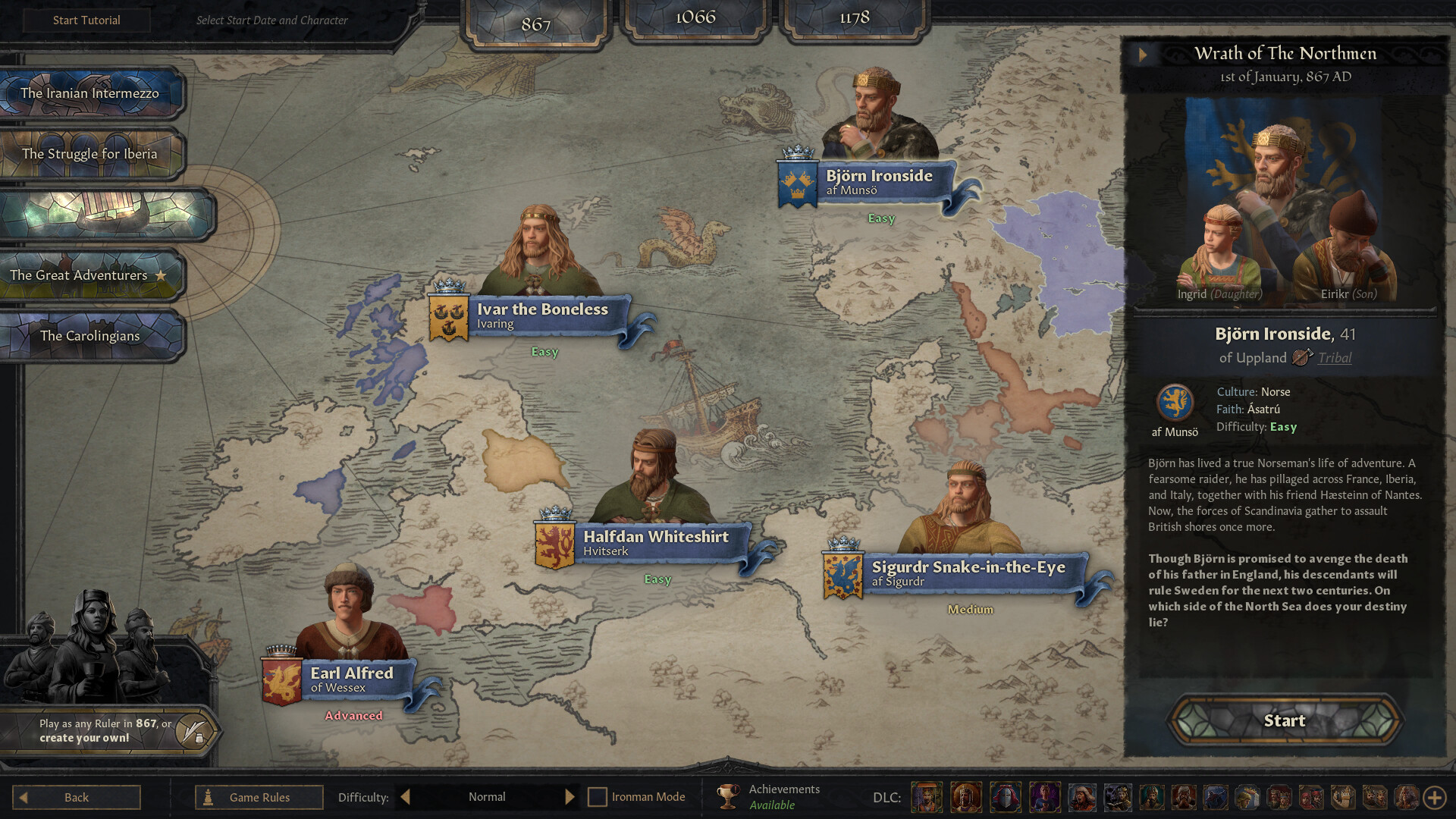
Third, start in the right bookmark. The 1066 bookmark, Channels of Commerce, is where the famous merchant houses begin, and it is the best first run. The 1178 bookmark is the republic showcase, better saved for your second campaign.
Pick a purpose and commit
Your company has a purpose, the specialization that shapes what it is good at. The store page names three.
Caravaneer moves goods along the longest routes. Creditor lends gold and collects leverage instead of rent. Artisan makes artifacts in workshops and crafts the things the world wants.
Each purpose has a capstone decision that firmly establishes your reputation in that role and unlocks a unique domicile upgrade. Each capstone costs 1,500 prestige: Establish Caravaneer Reputation, Establish Artisan Reputation, and Establish Creditor Reputation. One character can finish all three Merchant Trait tracks, which is its own achievement, Multi-Track Merchanting, but that is a long game. For your first campaign, pick one purpose and commit to it.
One correction to an early claim, including one on this site. A fourth purpose, Reputable, was mentioned in a pre-release dev diary, but it has no matching decision in the live 1.21 game files. Treat the three purposes as the real choice.
Your domicile and your patron
A merchant is landless, but you still need a base. Your company runs from a domicile in a city, and the holder of that county is your Patron. You become their Beneficiary, a new kind of tributary. Your patron is your first relationship and your first source of work.
Two things matter most. First, moving your company destroys every route you have, so choose where to settle and stay there. A good domicile sits near markets with goods in demand. Second, your mansion grows with you. Spend gold and prestige to improve its grounds, and the upgrades add trade routes and give you an edge over rival traders. You can eventually upgrade your company to a Palace, which is its own achievement, City of Marbles.
You also want a charter from your patron, the document that formalizes your right to trade. The live game has the decisions Forge Charter, Direct Local Investment, and Abuse Charter Authority, but the exact steps to win one are not documented anywhere public yet. Work your patron relationship, watch for the decision in game, and we will update this section once the procedure is confirmed.
Your first profit route
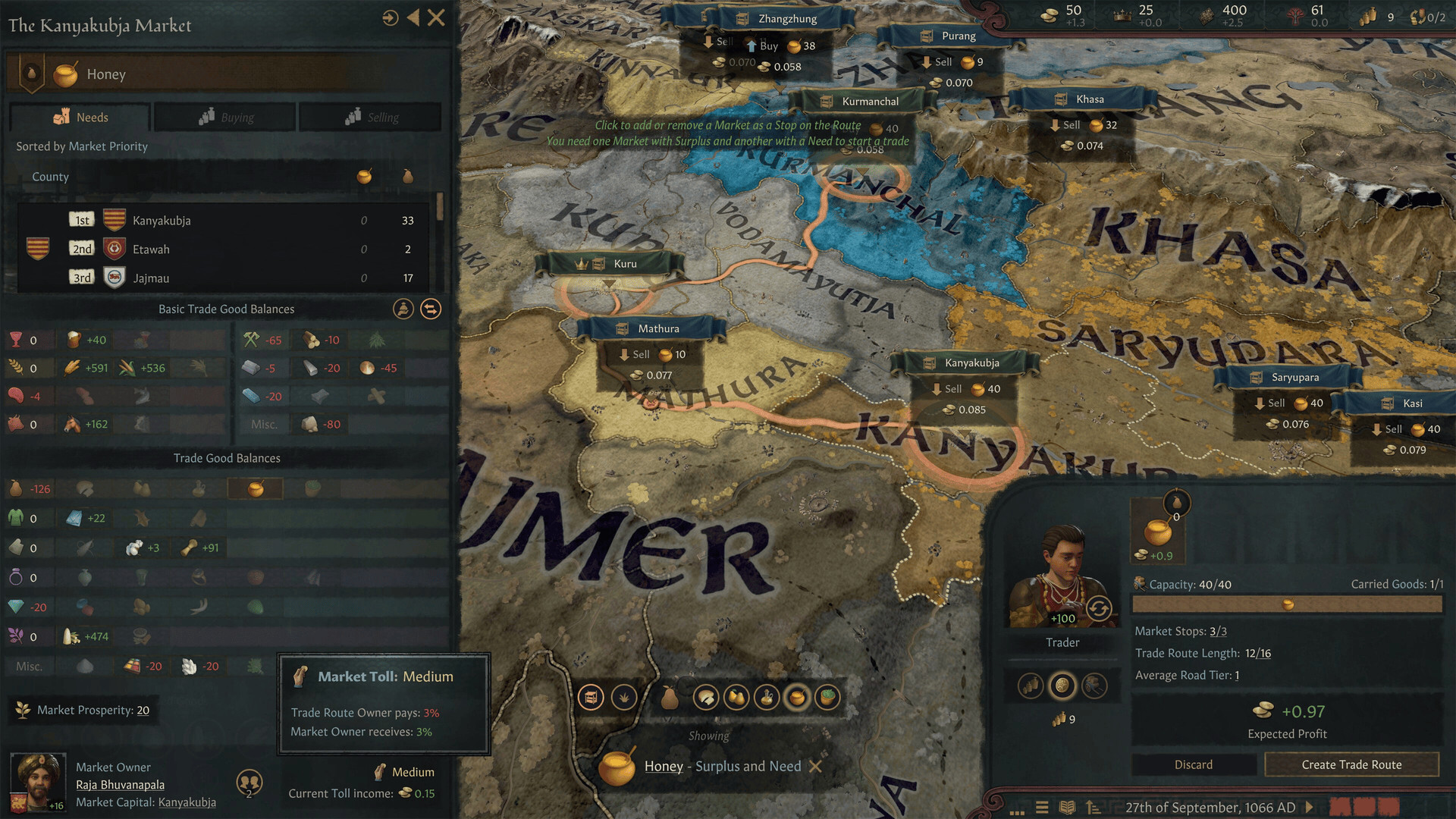
Trade routes are the core business. There are 922 Trade Markets, one for every de jure duchy on the map, and 44 trade goods across 20 need categories. The numbers below are the base values from Dev Diary 8, before modifiers, and they match the live game files.
- 1 Base Profit Route per merchant.
- 3 Markets per Profit Route, and 6 Max Trade Goods per Profit Route.
- 30 Base Trade Capacity for every merchant and patrician.
- 10 Base Route Length, counted in baronies along roads, with seas and navigable rivers included.
- 2 Trade Posts as a base value.
A Profit Route must always stop in one of your home markets: the market of your company base, or, for patricians, any market where your family has a trade post. The first good on a route is its Primary Good. It earns Trade Expertise, gets first call on capacity, and names the route. Expertise lives on your title rather than on the character, so it survives succession. There are 20 expertise levels per need category.
Each route has one Trader, assigned from your Associates or family members. A Trader’s skills shape what the route is good at: Competitiveness, Expertise, or Route Capacity. Market share follows Competitiveness, so a good Trader is worth more than a second route. A Trader set to Manage Competition can add 10 percent Competitiveness.
For your first route, keep it simple. Find a market with a surplus and a nearby market that needs it. Keep the route short, within your 10 barony base length. Assign your best Trader. Stick with one good long enough to build expertise before branching out.
Commission routes: easy money early
Sitting alongside your own routes are Commission Routes, jobs landed rulers offer when they need goods moved between their markets. Your patron picks one of their markets and a good, and you are contracted to deliver it there for 10 years. The ruler pays a lump sum up front.
Take one early. It is the fastest gold a new merchant sees. Two warnings. The base value is 1 Commission Route per merchant, and a pre-release summary says up to 4 by company size, but the company size thresholds are not confirmed in live play, so do not plan your income around four commissions. Cancelling a commission refunds only part of the payment and gives you the Dealbreaker secret, which other rulers remember. If your reputation takes a hit, the Wipe Slate decision atones for it, at a cost of 100 gold, 250 prestige, and 100 piety.
Grow the company
Growth runs on Acumen, your business savvy. It grows month by month based on the profit you actually pull in, not the volume you move or how many routes you run. A small, profitable company grows faster than a big, wasteful one. That is the design intent, and it shapes every choice below: pick profitable routes, not more routes.
Source: Paradox Interactive / official game screenshots
Your company grows from an Aspiring Business into a Trade Empire, with its own achievement, By Gold Alone, for reaching Trade Empire size as a merchant. The intermediate size tiers are not documented yet, so do not trust a tier list from before launch. Grow by profit, upgrade your mansion, finish your purpose capstone, and the size follows.
If you trade east, watch the Silk Road. Merchants in the region belong to a Participant Group that grants bonuses to maximum Route Length, Route Capacity, and Expertise decay, sized by the active Phase in your sub-region. The group works if you own Silk and Silver alone; it does not require All Under Heaven.
Loans and monopolies: the big levers
Once your routes pay, two levers turn gold into power.
Lending is the Creditor’s game, but any merchant can loan gold. A new Usury Doctrine gives each faith its own stance: condemned, allowed only with outsiders, or honest business. Doctrine changes the moral framing, not the availability. The dev diary summary lists three ways to lend: open interest, where they owe 25 percent more and a faith that condemns usury can void the debt; disguised interest, where they owe 15 percent more with the interest hidden; or lend for nothing, for the relationship. Treat the 25 and 15 percent figures as pre-launch diary numbers, not yet confirmed in live play. What is confirmed is the leverage: you hold a Strong Hook over the ruler for exactly as long as the debt lasts, and debts are inherited. The Loan Shark achievement, ten debtors at once as Wuhsha the Broker, shows how far the system goes.
Monopolies are the other lever. The market owner sets tolls, grants monopolies, and can issue Commission Routes. A monopoly covers either one Need Category or the whole market, a Complete Monopoly, and is either Normal or Exploitative. A Normal monopoly locks out competition without changing prices. An Exploitative monopoly lets the holder buy from the market’s total production, not just its surplus, taken out before local buildings are fed next month. A market can hold one Complete Monopoly, or one monopoly per Need Category. Granting a Complete Monopoly wipes out every category monopoly in that market, including the new holder’s own.
Monopolies do not expire. They are inherited, and they survive the market changing hands. They end when the market owner uses Rescind Monopoly, which cannot be refused but costs prestige, when a trade league holding one falls apart, or through war, since a trade league at 70 Cohesion can take one with the Enforce a Monopoly casus belli. The AI is very reluctant to grant them, and Complete is harder than category, Exploitative hardest of all.
Rivals: the other merchants want your markets
Sharing a market sours relations between merchant houses. The toolkit for dealing with competitors: steal trade secrets, challenge or sabotage a competitor, get their charter revoked, or undercut their prices. The endgame is the takeover: Merge Company, or a hidden Hostile Takeover scheme, which needs a company at least as large as theirs and a hook over them. The scheme requirements come from pre-release descriptions and are not yet confirmed in live play, so treat them as the shape of the system, not a recipe. Our merchant playstyle guide has the full rival toolkit.
Mistakes to avoid
Five mistakes will cost a new merchant campaign.
Do not move your domicile. It destroys every route you have.
Do not cancel a Commission Route lightly. The refund is partial, and the Dealbreaker secret follows you to every other ruler.
Do not spread across six goods at once. Expertise compounds in one need category.
Do not split prestige across all three capstones. Pick one and finish it.
Do not ignore your patron. Your charter, commissions, and monopolies all run through the ruler who holds your domicile county.
And one expectation to set before you buy: there is no naval warfare. Paradox said before launch that they chose not to add it, because the new systems already took the whole schedule. Sea power here means trade power, not fleets in battle.
What we still do not know
- The full 1.21 changelog. It is too large for a Steam post, and the details sit in a Paradox forum post.
- The loan percentages in live play. The 25 and 15 percent figures are pre-launch diary numbers.
- The exact steps to win a charter, and what a Beneficiary owes a Patron in practice.
- The intermediate company size tiers between Aspiring Business and Trade Empire.
- The Steam review score for the expansion. None existed at the time of writing.
- Whether the merchant game stays fun past the first century. No playthrough has run that far yet.
We will update this guide once we have played it ourselves and the forum changelog is fully public. For now, start in 1066, pick a purpose, take a commission early, and build your first route between a surplus and a need.
Sources: Paradox Dev Diary 2, Trade Vision; Dev Diary 6, Merchants, Republics and the Silk Road; Dev Diary 8, Trade in Practice; Dev Diary 10, achievements and domiciles; Steam store page for Crusader Kings III: Silk and Silver (price $29.99, live 17 November 2026); Paradox launch release, 17 November 2026, via Cision; Rock Paper Shotgun hands-on, 16 November 2026 (Marco Sanudo Venice session); YouTube, Venice the Menace Ep1 (Venice 1178 launch-day playthrough); ck3db Silk and Silver page and 1.21.0 decisions index (live game files); Grand Strategy Hub merchant playstyle guide and worth-it verdict. The CK3 wiki was not usable as a post-launch source at the time of writing, it still showed pages verified for 1.20 only.