How to Make Gold as a Merchant in CK3 Silk and Silver
Source: Paradox Interactive / official game screenshots
Silk and Silver is live since 17 November 2026, for $29.99, with the free Update 1.21 the same day. The current patch is 1.21.0.3. A merchant company is the only way to play CK3 where gold is the whole game, and this guide covers how that gold is actually made: profit routes, commission routes, loans, monopolies and artifacts.
One honest note first. We have not played it ourselves yet. This guide is built from launch-day playthroughs, the Paradox dev diaries, the Steam page and the live 1.21 game files. Four days after launch, no playthrough has published tested gold per year figures from a full campaign, so this guide gives you the verified mechanics and the one hard number Paradox itself published, and says plainly where a number is still unconfirmed. Our how to play a merchant guide covers starting a company, and our merchant playstyle guide goes deeper on the systems.
How merchant gold works
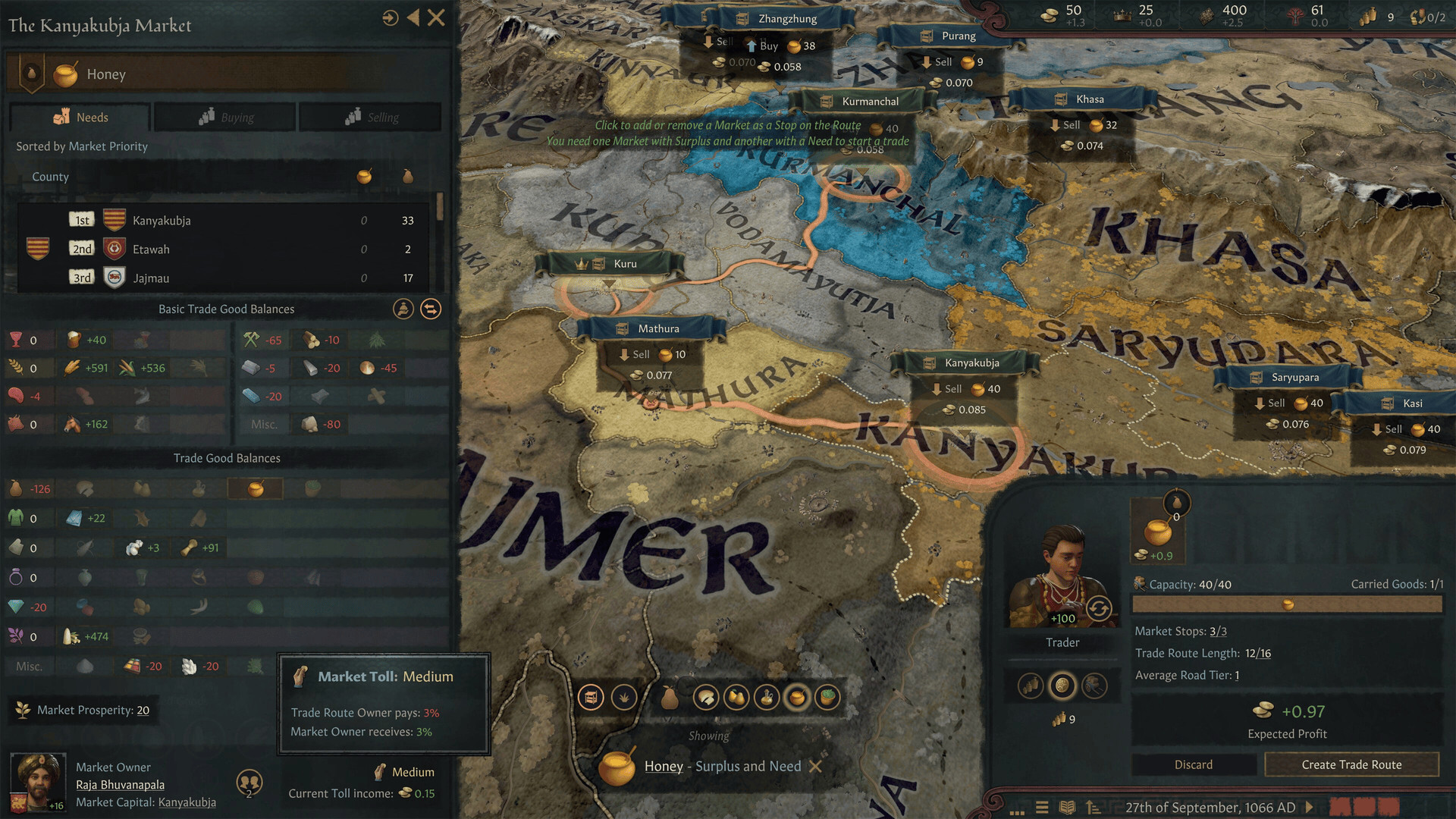
A merchant buys surplus cheap and sells it where it is needed. Every good has a base price, and two things move it most: Prosperity and modifiers. Scarcity does not change prices. Paradox tried it early in development and dropped it. In the diary’s words, scarcity only decides how much you can trade, not what it costs.
Prosperity is the lever that matters. The sell price rises 0.5 percent for every point of average Prosperity, up to plus 50 percent at 100. The buy price stays flat at 50 Prosperity or above, then drops 0.3 percent for every point below 50, down to minus 15 percent at 0. The rule is simple: buy in struggling Markets and sell in thriving ones.
| Market Prosperity | Sell price | Buy price |
|---|---|---|
| 100 | +50% | Base |
| 50 | +25% | Base |
| 0 | Base | -15% |
There are 922 Markets, one for every de jure duchy with at least one county, and 44 trade goods across 20 need categories. Each month a Market adds up its production and needs, feeds its own buildings, and works out its surplus and its deficit. Those two numbers are what trade works with. Markets and routes each do their monthly work on their own day, spread across 30 daily buckets, so up to a month can pass between a route selling a good and the destination’s buildings getting it. Do not expect instant returns.
What a route actually earns
Early trade is small money. Paradox’s own worked example, cured meat on a route with the base 30 capacity, comes out at about 0.41 gold a month. That is the only hard income figure published so far, and it is a starting point, not a ceiling. The gold grows as your capacity, expertise and Competitiveness grow.
The base values, from Dev Diary 8 and matching the live game files: 1 Base Profit Route per merchant, 3 Markets per Profit Route, 6 Max Trade Goods per Profit Route, 30 Base Trade Capacity, 10 Base Route Length counted in baronies along roads, and 2 Trade Posts. A Profit Route must always stop in one of your home markets.
Three things raise what a route pays. First, capacity. More capacity moves more goods, and mansion upgrades and company growth add routes and capacity. Second, expertise. The first good on a route is its Primary Good. It gets first claim on capacity, gives the route its name, and earns Trade Expertise in its category. There are 20 expertise levels per need category, and expertise lives on your title, so your heir keeps it. Stick with one good long enough to build expertise before branching out. Third, Competitiveness. When several routes trade the same good in a Market, each gets a share of the surplus or deficit in proportion to its Competitiveness, which starts at 10 for every ruler. A Trader set to Manage Competition can add 10 percent Competitiveness. If nobody else trades the good, your share is 100 percent.
Two more facts shape route income. Routes left running between the same markets for a long time gain boons, so a settled route pays better than a new one. And prices move with the world: wars or plagues in a region change what its markets pay. Prune and rework routes when the map changes. One warning: Distribution Routes are served before any Profit Route, so a large duke’s own lands get their basic supplies first, and merchants compete for what is left. The 18 November hotfix also fixed a bug where trade routes sometimes sold goods at a stop instead of buying at the cheapest one, which had been losing merchants money.
The five income streams
Routes are the engine, but they are not the only way a merchant earns. Ranked by how soon they pay:
1. Commission routes, the fastest early gold. A landed ruler hires you to move one good to one of their markets, and pays a lump sum up front. The contract lasts 10 years. Take one early. It is the fastest gold a new merchant sees. Two warnings. The base value is 1 Commission Route per merchant, and a pre-release summary says up to 4 by company size, but the company size thresholds are not confirmed in live play, so do not plan your income around four commissions. Cancelling a commission refunds only part of the payment and gives you the Dealbreaker secret, which other rulers remember. If your reputation takes a hit, the Wipe Slate decision atones for it, at a cost of 100 gold, 250 prestige and 100 piety.
2. Profit routes, the steady income. This is the long game. One good, one route, built up over years. Pick a good with a real deficit at the far end, keep the route short at first, assign your best Trader, and let expertise compound. Rock Paper Shotgun’s hands-on writer ran routes from France west to Africa south to Hungary east, and found this the most reliable earner of the three specializations.
3. Loans, the Creditor’s game. Any merchant can lend gold, but this is the Creditor purpose in full. The dev diary summary lists three ways to lend: open interest, where they owe 25 percent more and a faith that condemns usury can void the debt; disguised interest, where they owe 15 percent more with the interest hidden; or lend for nothing, for the relationship. Treat the 25 and 15 percent figures as pre-launch diary numbers, not yet confirmed in live play. What is confirmed is the leverage: you hold a Strong Hook over the ruler for exactly as long as the debt lasts, and debts are inherited. The Loan Shark achievement, ten debtors at once as Wuhsha the Broker, shows how far the system goes. A loan is not just interest. It is a hook over a king, and hooks are worth more than the interest.
4. Monopolies, the late game lock-in. The market owner sets tolls, grants monopolies, and can issue Commission Routes. A monopoly covers either one Need Category or the whole market, a Complete Monopoly, and is either Normal or Exploitative. A Normal monopoly locks out competition without changing prices. An Exploitative monopoly lets the holder buy from the market’s total production, not just its surplus, taken out before local buildings are fed next month. A market can hold one Complete Monopoly, or one monopoly per Need Category. Monopolies do not expire. They are inherited, and they survive the market changing hands. They end when the market owner uses Rescind Monopoly, which cannot be refused but costs prestige, when a trade league holding one falls apart, or through war. The AI is very reluctant to grant them, and Complete is harder than category, Exploitative hardest of all. Two achievements are built on them: There Can Be Only One, for seven monopolies at once, and In Sweden we have a System, for maxing out Alcohol expertise and holding an Alcohol monopoly in your home Market.
5. Artifacts and the mansion, the Artisan’s game. The Artisan purpose makes artifacts in workshops and crafts the things the world wants. Nine goods cannot be produced in any county at all, cheese, cured meat, beer, textiles, leather, glass, jewelry, lacquerware and books, and only come from buildings that convert other goods. Feed a Weavers’ Guild 30 Fabric, for example, and it produces 10 Textiles. That conversion chain is where Artisan gold comes from: buy the cheap input, sell the finished good. Your mansion grows with you. Spend gold and prestige to improve its grounds, and the upgrades add trade routes and give you an edge over rival traders. You can eventually upgrade your company to a Palace, which is its own achievement, City of Marbles. Each purpose also has a capstone decision that costs 1,500 prestige and unlocks a unique domicile upgrade, so pick one purpose and finish it before spending prestige elsewhere.
Which purpose makes the most gold
There is no verified universal ranking. Each purpose earns differently, and the honest answer depends on how you play.
Caravaneer is the strongest pick for pure route income. Rock Paper Shotgun’s writer found it the most lucrative of the three, earning enough gold to buy land containing a home market and be anointed a Sheikh. If your goal is the biggest pile of gold, start here.
Creditor is the strongest pick for turning gold into power. The interest is real money, but the Strong Hook over a debtor ruler is worth more than the interest, because it buys favors, votes and marriages. If your goal is a republic throne, lend.
Artisan is the strongest pick for steady, quiet income. Conversion buildings turn cheap inputs into pricey goods, and crafted artifacts sell to collectors. It is the least documented of the three so far, and its best numbers are still unconfirmed.
For a first campaign, pick Caravaneer. It teaches the route system, which every merchant needs, and its income is the easiest to see and grow.
Source: Paradox Interactive / official game screenshots
Where to trade
Location is half the income. A few rules to pick your ground:
Trade the Silk Road. Merchants in the region belong to a Participant Group that grants bonuses to maximum Route Length, Route Capacity and Expertise decay, sized by the active Phase in your sub-region. The group works if you own Silk and Silver alone. It does not require All Under Heaven.
Use entrepots. Entrepots are special districts in famous trade cities along the Silk Road, including Cairo, Baghdad, Constantinople and Venice. Goods delivered to them are resold, so a second merchant can carry them on to Markets even further away. An entrepot only resells goods moving away from their origin, which is what stops merchants from trading the same goods in circles between two entrepots.
Watch the tolls. Market Owners profit from trade through tolls, in six levels: None (0%), Minimal (1%), Low (2%), Medium (3%), High (4%) and Very High (5%). Every Market starts at Medium. Tolls are taken only from sales on Profit Routes, never from buying, and the Market Owner, their direct vassals and their merchant clients pay none. Changing tolls has a 36-month cooldown. Steep tolls push merchants to sell elsewhere, and a merchant can ask for a Toll Exception that sets their personal rate for 10 years.
Mind the roads. Route length is counted in baronies along roads, and roads raise maximum route length by 5 percent at tier 1 up to 25 percent at tier 5. Roads grow as routes use them and decay when trade stops.
Mistakes that lose gold
Five mistakes will cost a merchant campaign its income.
Do not move your domicile. It destroys every route you have. Choose where to settle and stay there.
Do not cancel a Commission Route lightly. The refund is partial, and the Dealbreaker secret follows you to every other ruler.
Do not spread across six goods at once. Expertise compounds in one need category, and a thin route in six goods earns less than a deep route in one.
Do not ignore your patron. Your charter, commissions and monopolies all run through the ruler who holds your domicile county. The exact steps to win a charter are still not documented anywhere public, so work the relationship and watch for the decision in game.
Do not pay tolls you can avoid. Your patron’s markets cost you nothing, and a Toll Exception lasts 10 years. Ask before you reroute.
Source: Paradox Interactive / official game screenshots
What we still do not know
- Tested gold per year figures from a full merchant campaign. No playthrough has published them yet. We will update this guide when one does.
- The loan percentages in live play. The 25 and 15 percent figures are pre-launch diary numbers.
- The lump sums commission routes pay, and the company size thresholds for running up to 4 at once.
- Mansion upgrade costs and what each upgrade adds.
- The exact steps to win a charter, and what a Beneficiary owes a Patron in practice.
- The intermediate company size tiers between Aspiring Business and Trade Empire.
Growth runs on Acumen, your business savvy. It grows month by month based on the profit you actually pull in, not the volume you move or how many routes you run. A small, profitable company grows faster than a big, wasteful one. That is the design intent, and it is the whole guide in one line: pick profitable routes, not more routes. Start in 1066, pick Caravaneer, take a commission early, build one route between a surplus and a need, and let expertise do the rest.
Sources: Paradox Dev Diary 8, Trade in Practice; Dev Diary 6, Merchants, Republics and the Silk Road; Dev Diary 2, Trade Vision; Steam store page for Crusader Kings III: Silk and Silver (price $29.99, live 17 November 2026); Paradox launch release, 17 November 2026, via Cision; Rock Paper Shotgun hands-on, 16 November 2026 (Marco Sanudo Venice session); HowToVideoGame, Crusader Kings III: Silk and Silver, How Trade Goods Work (dev diary figures, with the pre-launch balancing caveat); ck3db Silk and Silver page and 1.21.0 game files; Grand Strategy Hub merchant playstyle guide, how to play a merchant guide and worth-it verdict. The CK3 wiki was not usable as a post-launch source at the time of writing, it still showed pages verified for 1.20 only.