EU5 New Player's Path
Checked against patch 1.3 on Oct 12, 2026. Patch 1.4 (Rio Salado) releases Oct 28 and may change some details. Written by Tom Becker.
You just bought EU5, unpaused the game, and now dozens of systems are demanding your attention. This page is a judgment about the order that works: which systems to learn first, which to ignore until later, and how to tell when you are ready to move on.
I am stuck right now
Skip the stages and start here. Find what you are seeing, try the first fix, and follow the link for the full explanation.
| What you are seeing | Most likely cause | First thing to try | Where to read more |
|---|---|---|---|
| Money is dropping every month | Army maintenance, estate privileges, new buildings | Shrink the army to what the budget carries, then check which privileges you accepted | Economy basics |
| Treasury hit zero and a loan appeared on its own | Ending a month in the red takes a loan automatically | Stop the deficit before borrowing more, and check the interest rate | Loans and government bonds |
| Newly conquered land is rebelling | Culture and religion tolerance, low control | Accept the local culture and religion for now instead of forcing conversion | Culture and religion tolerance |
| An estate’s satisfaction is falling | Tax rate on that estate pushed too high | Lower the rate, or use the automatic setting, which holds it around 50 | Economy basics |
| A culture suddenly lost a lot of satisfaction | You downgraded its acceptance tier, which costs about 50% satisfaction | Check the Culture panel before touching tiers again | Culture and religion tolerance |
| You do not know what your government type lets you do | Government sets laws, succession, and reforms | Read what your government is and what it unlocks | Government types |
| Wars keep going badly | Army composition and troop quality | Check your composition, then test it in the simulator before the next war | Army composition and the Army Simulator |
| Everything is red at once | Several of the above | Fix money first, then unrest, then everything else | Start at Stage 2 |
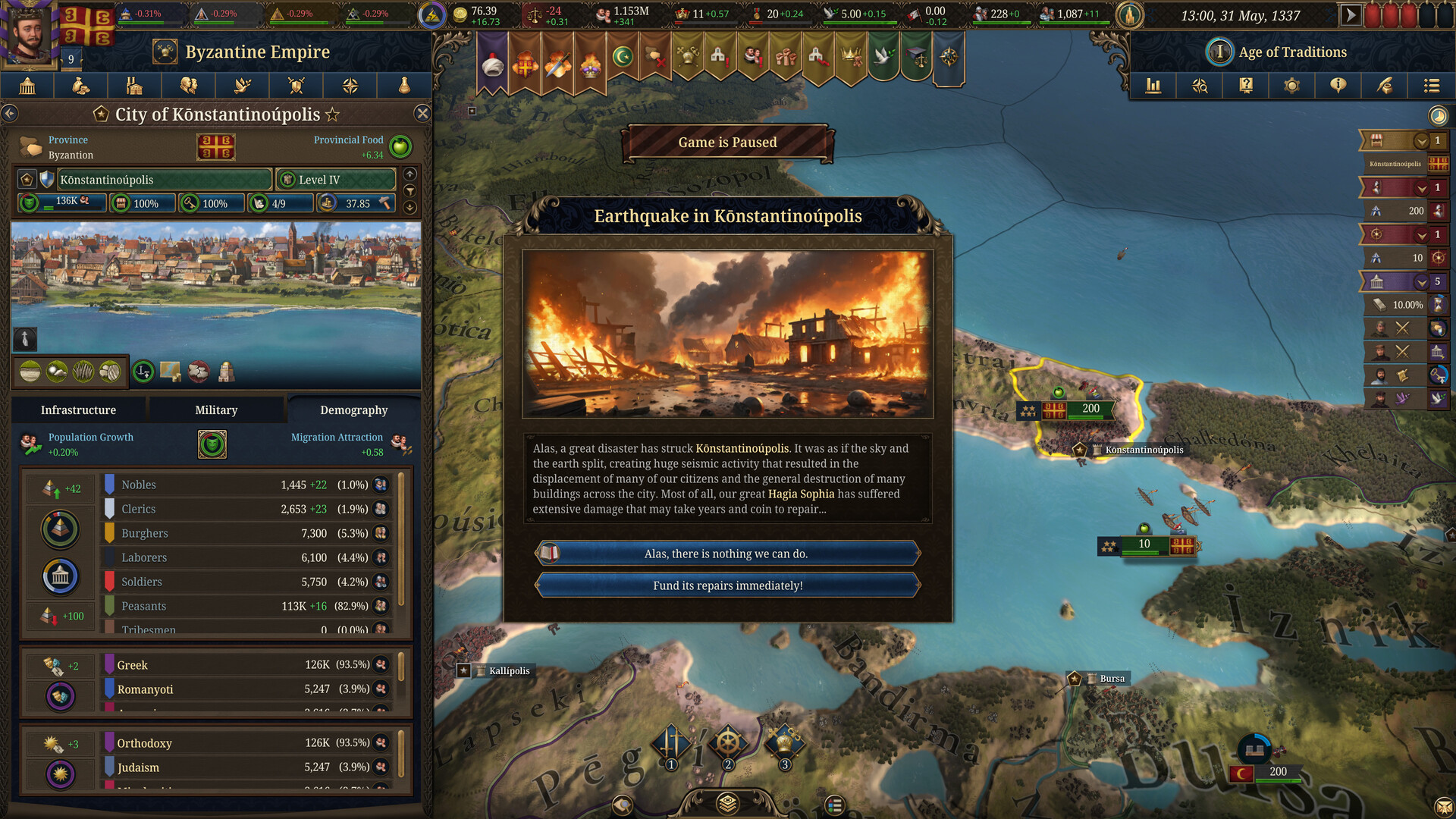
Source: Paradox Interactive / Europa Universalis V official screenshots
Stage 1: Orientation (first 30 minutes)
About 30 minutes of play. Rough estimate, not a rule.
Start with the right mental model, because EU5 is not EU4 with a new coat of paint.
EU5 is a population game. Your locations contain pops, and pops are the engine your whole country runs on. They produce your goods, pay your taxes, and supply your armies. When they are unhappy they produce unrest instead. Almost every other system in the game is a consequence of how your pops are doing.
If you are coming from EU4, the biggest thing to unlearn is right here: you managed provinces in EU4, and here you manage pops. Pops have opinions.
Before you start: pick one of the best starting nations for new players. Leave the game rules at their defaults for a first campaign. The defaults are fine, and changing rules you do not understand yet only adds confusion.
Your first-year routine:
- Pause the game the moment the campaign loads.
- Look at the top bar and find income versus expenses. Know whether you are in the black or the red.
- Open the estates panel and look at each estate’s satisfaction. You do not need to act on it yet. Just look.
- Do not declare any war. Not a small one, not an easy one.
- Unpause at the slowest speed and let a year pass while you watch the numbers.
Do these 3 things:
- Pick a beginner nation and start the campaign.
- Learn to read the top bar: income, expenses, and what is eating the treasury.
- Survive one full year at peace without the treasury shrinking.
What to ignore for now: the trade mapmode, the institutions tab, parliament agendas, naval composition, and any notification about ages. None of it matters in your first hours, and every one of them has its own stage later.
You are ready for Stage 2 when:
- You have unpaused, picked a nation, and started a campaign.
- You can say whether you are in the black or the red.
- You have not declared a war yet.
- You know where the estates panel is.
Guides for this stage:
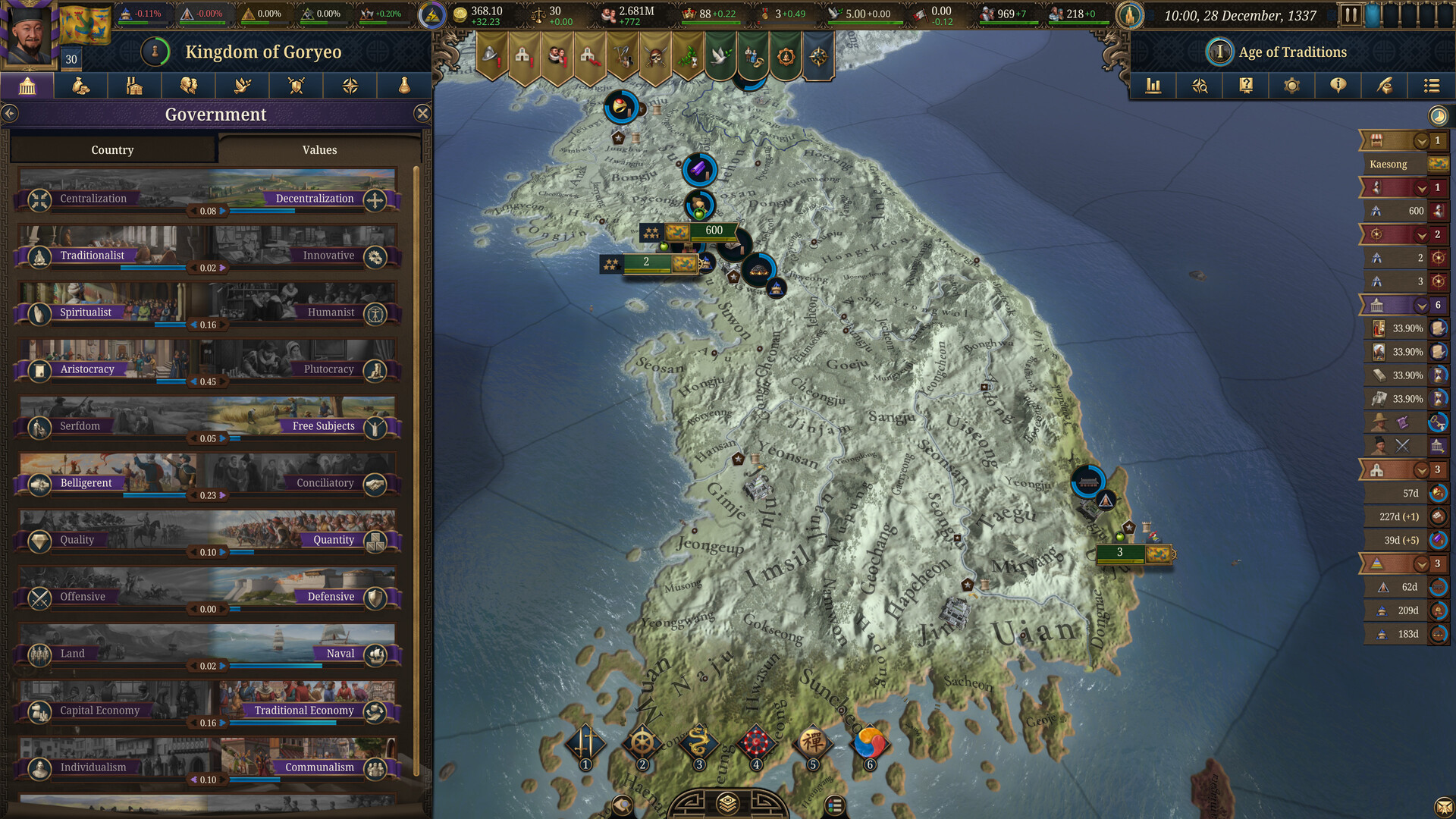
Source: Paradox Interactive / Europa Universalis V official screenshots
Stage 2: Foundation (what breaks the game if ignored)
About 1 to 2 hours of play. Rough estimate, not a rule.
Two systems sit underneath everything else, and both are worth learning before you look at the flashy stuff.
Do these 3 things:
- Read the pop guide, then open the population tab in your biggest location and name the classes living there.
- Learn what your government type is and one thing it allows you to do.
- Learn where your income comes from and what drains it, so you can spot the spiral before it starts.
What to ignore for now: detailed estate privileges, unrest management tactics, and army composition. They get their own stages.
You are ready for Stage 3 when:
- You can name your government type and one thing it allows.
- You can name the pop classes in your biggest location.
- You know where your money comes from and what your three biggest expenses are.
Guides for this stage:
- Pop system explainedThe eight social classes, what pops need, and why they decide whether your budget lives or dies.
- Government types explainedWhat your government lets you do: succession, laws, reforms, and how a tribe modernizes.
- Economy basicsWhere income comes from, what drains the treasury, and the spiral that ends campaigns.
Stage 3: Stabilization (the danger zone)
About 2 to 3 hours of play. Rough estimate, not a rule.
A common first crisis is estate satisfaction and unrest hitting at once, a few years into the campaign. This stage is about surviving that.
Do these 3 things:
- Check every estate’s satisfaction and power in the estates panel, and learn what each estate wants from you.
- Learn what unrest is telling you: it is unhappy pops signaling a cause, not a number to suppress.
- Set your culture and religion policy to accept first. Accept now, convert later.
What to ignore for now: advanced military tactics, trade networks, institutions, ages, and cabinet optimization. The country surviving is the goal, not min-maxing.
You are ready for Stage 4 when:
- No location is rebelling or about to.
- Your treasury is not shrinking month over month.
- You know what each estate wants from you and what your privileges cost.
Guides for this stage:
- How estates workEstate power and satisfaction, what privileges really cost, and the beginner rules for granting them.
- How to manage unrestWhat causes rebels, how to stabilize new conquests, and the response order that works.
- Culture and religion toleranceWhy mixed-pop conquests rebel, and the accept-now-convert-later rule.
Stage 4: Growth (once you are stable)
About one full campaign. Rough estimate, not a rule.
This stage only starts after the country is not on fire. Now you can actually improve things.
Do these 3 things:
- Build an army that can win its first real war, and test the composition in the simulator before you pay for it.
- Learn who your cabinet and courtiers are and what their skills actually do.
- Use diplomacy so you never fight alone against a coalition: alliances, rivals, and reputation.
What to ignore for now: naval warfare details, institution min-maxing, and age objectives. One system at a time, one campaign at a time.
You are ready for Stage 5 when:
- You have fought and finished at least one war.
- Your budget is stable during peacetime.
- You have used the army simulator at least once.
Guides for this stage:
- Army composition basicsHow the levy and professional troop system works, and how to build an army that wins.
- EU5 Army SimulatorTest a composition against an enemy before you commit gold to it.Tool
- Societal values explainedWhat the value sliders change about your laws, diplomacy, and direction.
- Cabinet and courtiers explainedWhere your characters come from, and why their skills drive combat, sieges, and institutions.
- Parliament explainedHow laws get passed, what the agendas stake, and why ignoring it costs you.
- Diplomacy guideAlliances, rivals, and reputation: the relationships that keep you from being dogpiled.
Stage 5: Depth (the long game)
Ongoing. Rough estimate, not a rule.
These systems matter more as a campaign matures. You do not need deep mastery of any of them in your first campaign.
Do these 3 things:
- Learn how ages and institutions unlock progress over a long campaign.
- Learn how battles and sieges are actually decided, so wars stop feeling random.
- Decide whether trade, the navy, or neither fits what you want this campaign to be.
What to ignore for now: trying to master all of these in one campaign. Pick the one your current goal needs and leave the rest for the next run.
Guides for this stage:
- Ages explainedThe six eras, what each unlocks, and how to plan a campaign around them.
- Institutions explainedThe 18 institutions, embrace thresholds, and how they unlock advances.
- Combat explainedBattle phases, flanking, frontage, terrain, and the defensive stats that win fights.
- Sieges explainedHow sieges work, assaults, artillery, and why some forts fall in weeks and others hold for years.
- EU5 Siege LabTest siege setups before your army sits outside a fort for a year.Tool
- Navy guideWhich ships to build, how naval combat works, and when ships are worth the money.
- Trade guideHow trade routes work, how to use merchants, and how goods and markets move money.
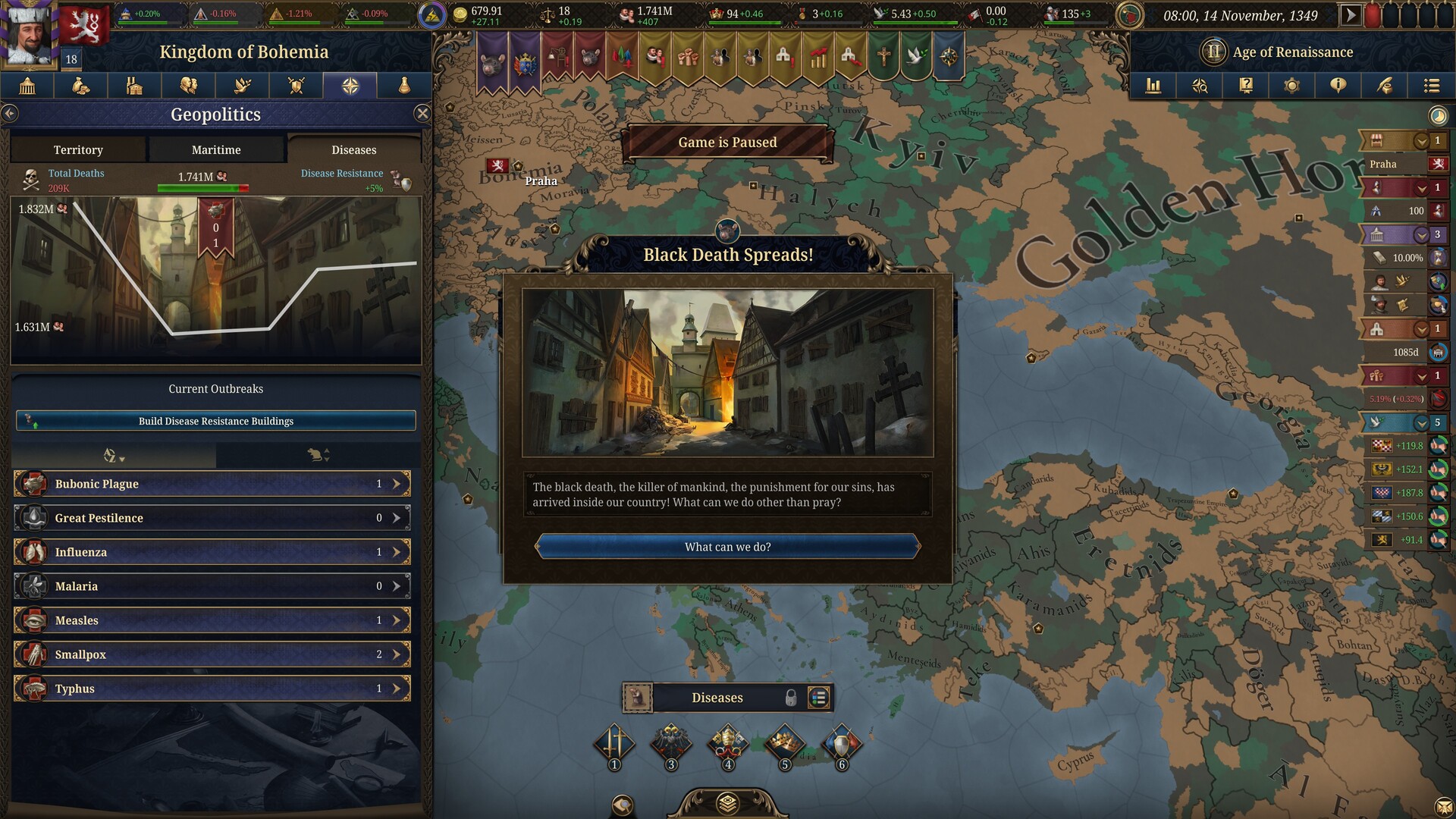
Source: Paradox Interactive / Europa Universalis V official screenshots
Where to go from here
Pick a goal for your next campaign and let it choose your reading:
- To conquer: army composition, combat, sieges.
- To get rich: trade guide, most profitable buildings.
- To survive as a small nation: diplomacy, estates.
- To play tall and learn the systems: institutions, ages, societal values.
Coming from EU4? Unlearn these first
EU5 looks like EU4 and plays like a different game. These are the habits that get EU4 veterans killed:
- Provinces are now locations. You do not develop a number on the map. You manage the pops inside each location.
- Mana is gone. No monarch points to spend. Progress comes from pops, characters, and institutions.
- Pops have classes, cultures, religions, and opinions. Eight classes: nobles, clergy, burghers, laborers, soldiers, peasants, tribesmen, slaves. There is no farmer or artisan class.
- Estates are central, not a side panel. They demand privileges and satisfaction, and ignoring them breaks the country.
- Unrest is a signal, not a number. It tells you which pops are unhappy and why. Suppressing it without fixing the cause just delays the rebels.
- Tolerance decides whether conquests rebel. Accept cultures and religions now, convert them later. Forcing it on day one is how rebellions start.
- Control matters twice. It multiplies your tax base and it slows assimilation when it is low.
- Fast conquest punishes harder than in EU4. Take what you can stabilize, not what you can conquer.
The full comparison lives in the EU4 vs EU5 differences guide.
A final word
This path exists for one reason: to keep your first campaign standing long enough for the game to get good. Come back to it whenever you feel stuck or overwhelmed, use the stage you need, and keep moving.
One timing note: update 1.4 “Río Salado” lands October 28 with major system changes, so expect some of the numbers on this path to shift once the stable release is out.