EU5 Beginner's Guide: Trade and Merchants Explained
New to EU5? This guide is part of the EU5 New Player’s Path. If you are just starting, follow the Path in order instead of jumping between systems. Trade in Europa Universalis V is one of the most important systems in the game, and also one of the most different from EU4. If you’re coming from EU4, you’ll need to unlearn some habits. The trade system has been significantly reworked. Here’s what you need to know to get started.
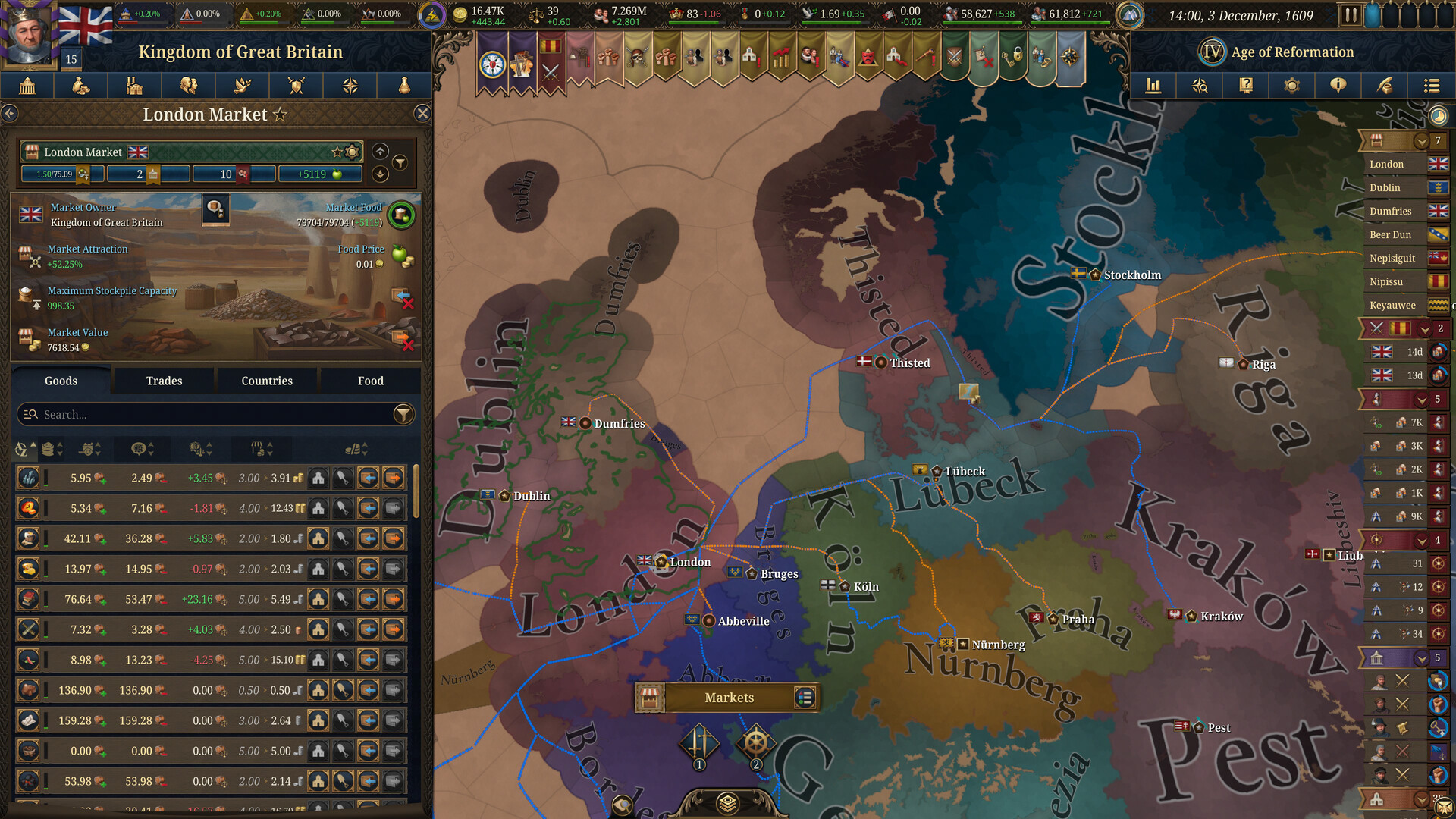
Source: Paradox Interactive, official EU5 Steam screenshot Trade ties directly into the economy, so pair this guide with how the economy basics work and the EU5 trade changes arriving in update 1.4.
Patch 1.4 changes trade — but only as much as you want it to. Update 1.4 turns Trade Orders into a priority queue and adds tariffs, subventions, and Promote Industry. If you like trade fully automated, leave it alone: the default experience barely changes. If you want control, the new section “New in Patch 1.4” below shows where to start. Full detail lives in the 1.4 economy and trade guide.
How Trade Works in EU5
The core concept is that goods are produced in provinces and flow through trade routes to where they’re needed. The key difference from EU4 is that EU5 uses a more dynamic trade system based on supply and demand, rather than EU4’s static trade nodes. Goods flow along routes based on what’s being produced and what’s being consumed, which means trade patterns can shift over time as economies change.
The key thing to understand is that trade is about connecting production to demand. Provinces produce goods, and those goods flow to places where they’re needed. Your job as a ruler is to position yourself to capture value from that flow. If you’re coming from EU4, you can see how the old trade node network worked visually with our interactive trade node map.

Source: Paradox Interactive, Development Diary 3 - Trade & Economics
Merchants
Merchants are your agents in the trade system. They’re assigned to trade routes and trade centers, and they help you capture more value from the goods flowing through your realm. Merchants are obtained through trade-related buildings, ideas, and certain nation bonuses.
The basics:
- Assign merchants to the most valuable trade routes you have access to
- Merchants in your home region are more effective than those far away
- You can move merchants between routes, but there’s a cooldown
Building a Trade Economy
Here’s a practical approach to building a strong trade economy as a beginner:
1. Focus on your home region first. Before you expand trade networks abroad, make sure your home region is well-connected. Build trade buildings in your capital and key provinces.
2. Control production. Trade is only as valuable as the goods being produced. Invest in production buildings in provinces with valuable goods: cloth, wine, iron, and other high-value resources.
3. Expand into trade routes. As you conquer territory, look for provinces that sit on important trade routes. Controlling the route is often more valuable than controlling the production.
4. Use your merchants wisely. Don’t spread your merchants thin. Focus them on the 2-3 most valuable routes and move them only when you have a clear reason.

Source: Paradox Interactive, Tinto Talks 124 - Economy, Trade & Tariffs
New in Patch 1.4: Trade Orders, Tariffs, and Promote Industry
This section is based on Paradox’s pre-release previews; the final patch notes had not been posted at the time this update was written, so treat the mechanics below as preview information until they are confirmed against the final notes.
Trade Orders become a priority queue. Orders higher in the list receive Trade Capacity first; whatever capacity is left trickles down to the next order, and finally to the regular automation. You can add unlimited orders — even more capacity than you have — and unserved orders simply wait as fallbacks until capacity frees up, without needing to be re-enabled by hand. Each order takes either a flat amount of capacity or a percentage of the market’s total. Three dynamic presets are confirmed: Any Export (finds the most profitable exports for the market), Any Pop need (imports whatever the market’s population is missing), and Any construction need (imports whatever ongoing constructions need).
Set your involvement level first. The rework is a ladder: level 1 is full automation (the default, barely changed from before, with a cleaner UI); higher levels hand you the priority queue with editable parameters — minimum acceptable profit, target markets, and a Profit, Food, or shortage-fixing focus. Beginners should start at level 1, then add ONE priority order (usually Any Pop need, to stop shortages) and watch what it does before adding more.
Tariffs and Subventions. Market Owners can now tax foreign trade happening inside their own markets with Tariffs — or use negative-tariff Subventions to encourage trade they want. If you own a market others trade through, tariffs are new income; if you trade through someone else’s market, their tariffs are a new cost to price into your routes. Tariff and subvention values were flagged not-final in the diaries, so no rate is stated here until the final notes confirm one.
Promote Industry. A new area-level action that specializes production, with slots scaling by rank, alongside nine early specialization Urban Rights plus two market-focused rights. For a beginner, the practical takeaway is simple: specialize areas that already produce something well instead of building a little of everything everywhere, and let the rights reinforce the specialization.
What does not change for beginners. Production still feeds trade, trade still feeds income, and merchants still capture value on your best routes. The 1.4 system adds control on top of that loop; it does not replace it. If your home region advice above still works, it is because the loop is the same — only the steering got better.
Common Beginner Mistakes
- Ignoring trade entirely. Trade income can be a huge portion of your economy. Even a small investment in trade buildings pays off.
- Spreading merchants too thin. One merchant on a minor route is worth less than two merchants on your best route.
- Not building production. Trade without production is like a shop with nothing to sell. Build both.
- Expanding into poor trade territory. Not all conquests are equal. Prioritize provinces that add trade value.
- Leaving Trade Orders on autopilot while expecting priority trades to happen. In Patch 1.4, automation serves your priority orders first and only then itself — if you never place an order, your most important import is just another automated trade. (Preview)
Trade in EU5 is a system that rewards attention. You don’t need to master every detail to benefit. Just understand that production feeds trade, trade feeds income, and merchants are your tools for capturing that income. Build your home economy first, expand into good trade territory, and keep your merchants focused on the best routes.
As you play more, you’ll develop a feel for which routes are worth fighting for. But for now, these basics will keep your economy healthy while you learn the rest of the game. Patch 1.4’s trade changes are covered in ‘New in Patch 1.4’ above; the 1.4 hub tracks the rest of the update.
Finished the Path? Head back to the New Player’s Path whenever you need it, or take the EU5 quiz to test what you learned.