EU5 1.4 'Río Salado' Update: Everything Confirmed So Far
Update 1.4 for Europa Universalis V, code-named Río Salado, is the biggest confirmed batch of changes this site has tracked in a single update, and it releases October 28, 2026, with the open beta live since October 1, 2026, per the September 22 Grand Voyage Roadmap update, which also named 1.5 “Fealty” and announced the 2.0 “Discovery Update,” all covered in the roadmap and beta date article. Everything below comes from the official Tinto Talks developer diaries that Paradox publishes weekly, read directly from the game’s Steam announcements page. Thirteen of them are in so far, Tinto Talks 117 through 129, and this page assembles the confirmed picture up to the most recent one. Treat the sections below as previews until the launch-day section below confirms what shipped. The developers have said repeatedly that preview numbers and mechanics can change. Two clarifications belong at the top because the community keeps tripping over them. Ambitions are not in 1.4; they were explicitly moved out to a future update called Discovery, currently targeted for Late 2027, which will also bring a Colonization rework and a content delivery overhaul. And the update itself is framed as centered on pre-1500s Iberia rather than on the colonization era.
The topics below are grouped by system, and each represents the confirmed state at the time of writing. The diaries did not all land in the order originally announced, so view the topics as confirmed and the announced schedule as history. Because this is a living document, it will be refreshed as new Tinto Talks post, and every section links out to a dedicated article where this site already covers a system in full.
Paradox released the official launch trailer on October 22. It leads with the trade-policy rework and Expeditions, with the Catholicism and dynasty overhauls behind them, and confirms the October 28 launch alongside the Across the Pillars Chronicle Pack at $19.99.
What is live at launch
The official 1.4 patch notes go up on launch day. As soon as Paradox publishes them, this section will list the changes that shipped and call out anything that differs from the Tinto Talks previews below. Until then, treat the sections below as previews, because the developers have said numbers and mechanics can change before release. For the changes most likely to affect your first campaign, start with the Political Influence guide, the 1.4 economy and trade guide, and the Decisions and Content Tab guide.
Every 1.4 guide on this site
- EU5 Political Influence: What Update 1.4 ‘Rio Salado’ Adds
- EU5 Decisions Are Back: The New Content Tab Explained (Update 1.4 Preview)
- EU5 Expeditions Explained: Circumnavigation, Treasure Fleet, Hajj
- EU5 1.4 Economy Overhaul: Trade Orders, Tariffs, Promote Industry
- EU5 1.4 Combat Changes: Cavalry Nerfed, Sieges Reworked
- EU5 1.4 Catholicism Rework: Cardinals, Crusades, Religious Orders
- EU5 Subjects Guide: Vassals vs Fiefdoms vs Dominions (Patch 1.4)
- EU5 Loans and Government Bonds: Debt and Bankruptcy (Patch 1.4)
- EU5 Most Profitable Buildings and Best Trade Goods to Produce (Patch 1.4)
- EU5 Navy Guide: Best Ships, Naval Combat and Maritime Presence (Patch 1.4)
- EU5 Estate Private Armies Explained: Noble and Cossack Regiments (Update 1.4)
- EU5 Parliament Explained
- EU5 1.4 Open Beta Confirmed for October 1, Plus What’s Coming in 1.5 and 2.0
- EU5 New Player’s Path
- EU5 Army Composition Basics: A Beginner’s Guide (Patch 1.4)
Politics and diplomacy
The headliner is Political Influence, a new 0 to 100 country currency representing the ruler’s political capital, and keeping it high raises base Crown Power by up to 20%. That system already has its own article on this site, so only its shape is repeated here, and the Political Influence guide carries the full detail.
Diplomacy gains new actions. Demand War Leadership and Offer War Leadership make war leadership something to negotiate rather than something that just happens. Inheritance Contracts let a paying monarchy buy the right to inherit an heirless monarchy, with the cost scaled by development and running roughly between 50 and 1500 gold. Betrothals turn marriages into promises, available for children aged two and up.
Hegemony antagonism gets flattened: the penalty is now a flat +10% instead of scaling up to +100% when you hold all five hegemonic titles, and each hegemony held grants +1 diplomatic reputation. The diplomacy automation overhaul is large. High-stakes actions like changing religion, primary culture, or succession law, declaring war, forming alliances, and joining International Organizations can no longer be automated at all. Automation now leaves alone the ongoing actions you personally started instead of cancelling them, fixing the automation keeps fighting me complaint, and the diplomat cap rises from 1 to 3. The same diary also introduced estate private armies for the Nobles and Cossacks, which have their own full guide on this site.
Decisions and the Content Tab
Decisions return as a feature, and they arrive inside a new Content Tab that centralizes a country’s unique reforms, advances, decisions, policies and laws, subject types, and units in one place. Many 1.4 decisions convert content that previously waited on a random event to fire into player-driven, clickable actions, and the developers are explicit that this is the first iteration of a content delivery system they will keep building on. Decisions can be single-use or repeatable, country-specific or generic, and each one shows a visible progress bar toward its requirements. Decisions now have their own full guide on this site.
Expeditions
Expeditions are the newest and most work-in-progress item in 1.4. The developers called them explicitly an early look, with the system still under development and being iterated on, so this section and the dedicated article lean on that warning rather than hiding it. The system has three flavored examples confirmed so far: Circumnavigation, a race to sail all the way around the world; the Treasure Fleet, a Middle Kingdom exclusive; and the Great Pilgrimage and the Royal Hajj, two religious expeditions. Hard numbers are thin everywhere in the diary, so next to no exact figures exist for any of these. The Across the Pillars DLC adds its own expedition content, shown in Tinto Talks 127: eight expeditions based on the Search for the Golden Cities, unlocked once America is discovered, plus Castilian Treasure Fleets, the Flota de Nueva España aimed at Mexican gold and the Galeones de Tierra Firme aimed at Andean gold. The full Expeditions guide covers all confirmed examples in detail.
Colonization and population
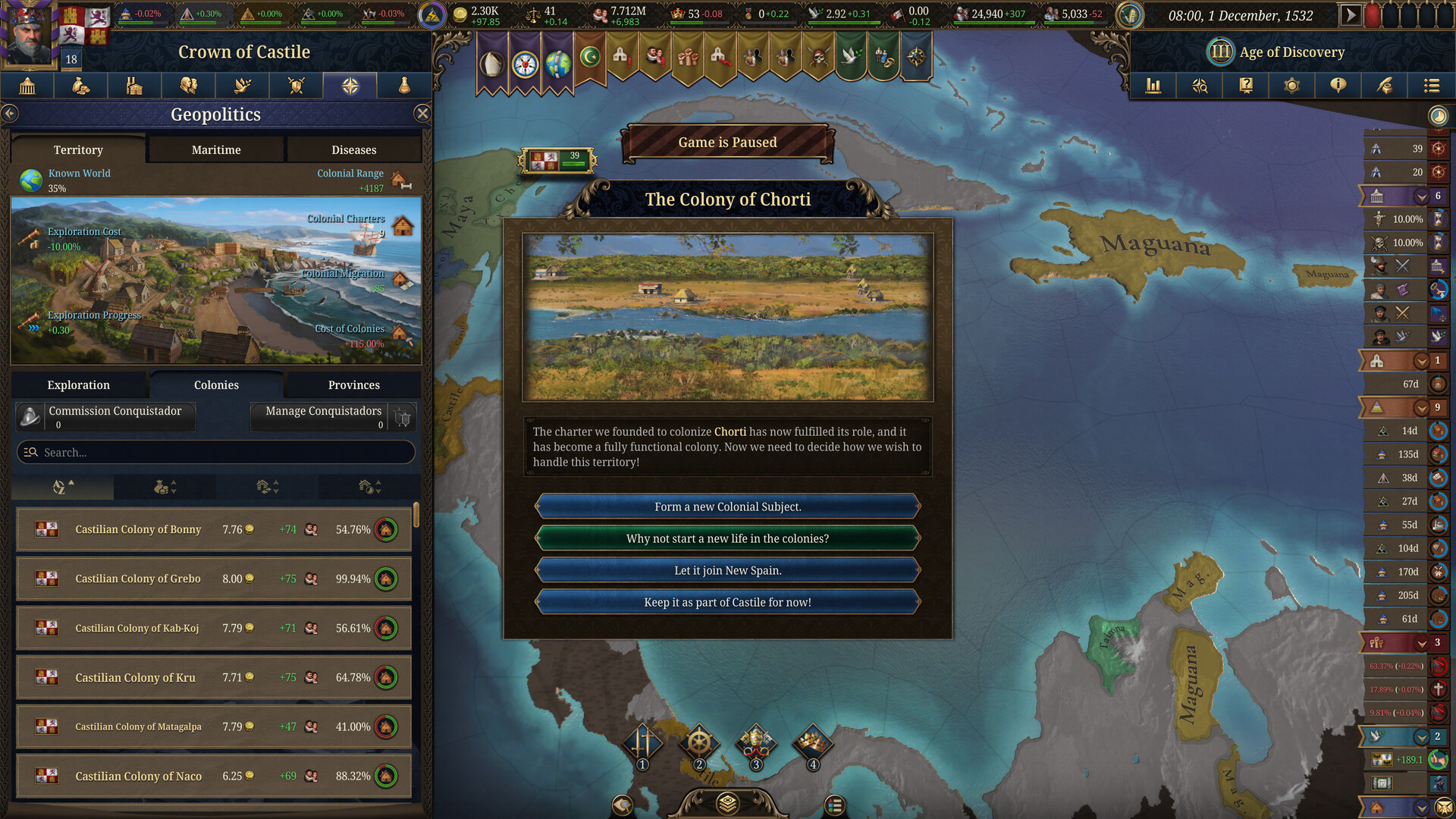
Colonization picks up clarity and direction. Colonial charters now let a player pick the goal up front, Form Colonial Nation, Join Colonial Nation, or Keep as Territory, instead of hitting an event popup at completion. Colonies get migration and ETA indicators plus milestone messages, and a fully self-sustaining colony is explicitly marked Self Sustaining. Conquistadors are built at a homeland port instead of a colonial port, gain auxiliary units to prevent starvation, and joining a conquistador war automatically makes you the war leader.
Population growth now comes from actual food surplus rather than hoarded stockpiles. Spare land no longer speeds growth by itself, growth slows as locations approach capacity, and overcrowded locations lose people. Large cities and harsh winters reduce local food production. A new Egyptian Plague endemic disease models over 50 historical Mamluk-era outbreaks between 1348 and 1517, spawning roughly every few years in the Nile delta and occasionally spreading to the Levant, and it runs on its own resistance track, so Black Death survivors get no immunity.
Cultures get a sharper tier system in the same diary cycle. The old Discriminated tier is renamed to Ignored, and a new level below it takes the Discriminated name. That new tier represents active oppression, dramatically increasing cultural assimilation at the cost of pop satisfaction and increased emigration, and countries dislike you for discriminating. Estates put forward Parliament agendas to accept or discriminate against cultures they like or dislike, which is a natural link to the Parliament guide already on this site. Migration also gets direct tools: an Age of Reformation advance unlocks a Direct Domestic Migration cabinet action that moves pops from one location to another over ten years.
Mercenaries and combat
Mercenaries get more expensive and more demanding. Hiring costs roughly twice as much upfront and 35% more in monthly upkeep, they consume 50% more food in the field than regulars, and hiring from rival-owned soil carries a 25% default hostile territory surcharge. A new Mercenary Market law arrives in the Age of Renaissance with four policy options: Condottieri Business, Open Markets, Restricted Markets, and Unrestricted Market, which is the 1.3 default.
Combat numbers shift down across the board. Cavalry combat power drops from 4 to 3.25, the flanking bonus is cut from +110% for light cavalry and +100% for heavy down to +60% for both, and the Napoleonic Warfare advance is reworked to grant +5% discipline instead of ignoring zones of control. Sieges get a smaller stepping-stone rework: artillery now needs only 2 regiments per bonus point against forts instead of 3, and forts auto-surrender below 5% garrison strength instead of below 10 defenders, ahead of the bigger siege rework the developers say is planned for 1.5. Both systems get their own dedicated deep-dive on what changes in 1.4.
Economy and trade
The September 16 diary, Tinto Talks 124, brings the largest confirmed economic overhaul of the update so far. Trade Orders become a priority queue at the heart of an involvement ladder that runs from full automation to full manual control, with editable parameters like minimum acceptable profit, target Markets, and a Profit, Food, or shortage-fixing focus. Tariffs and negative-tariff Subventions let Market Owners tax foreign trade happening inside their own Markets, and a new Promote Industry action specializes production at Area level with slots that scale by rank. Nine early specialization Urban Rights plus two Market-focused rights are confirmed, with the diary noting their values are not final. Every confirmed change is covered in the dedicated 1.4 economy and trade guide.
Catholicism and religion
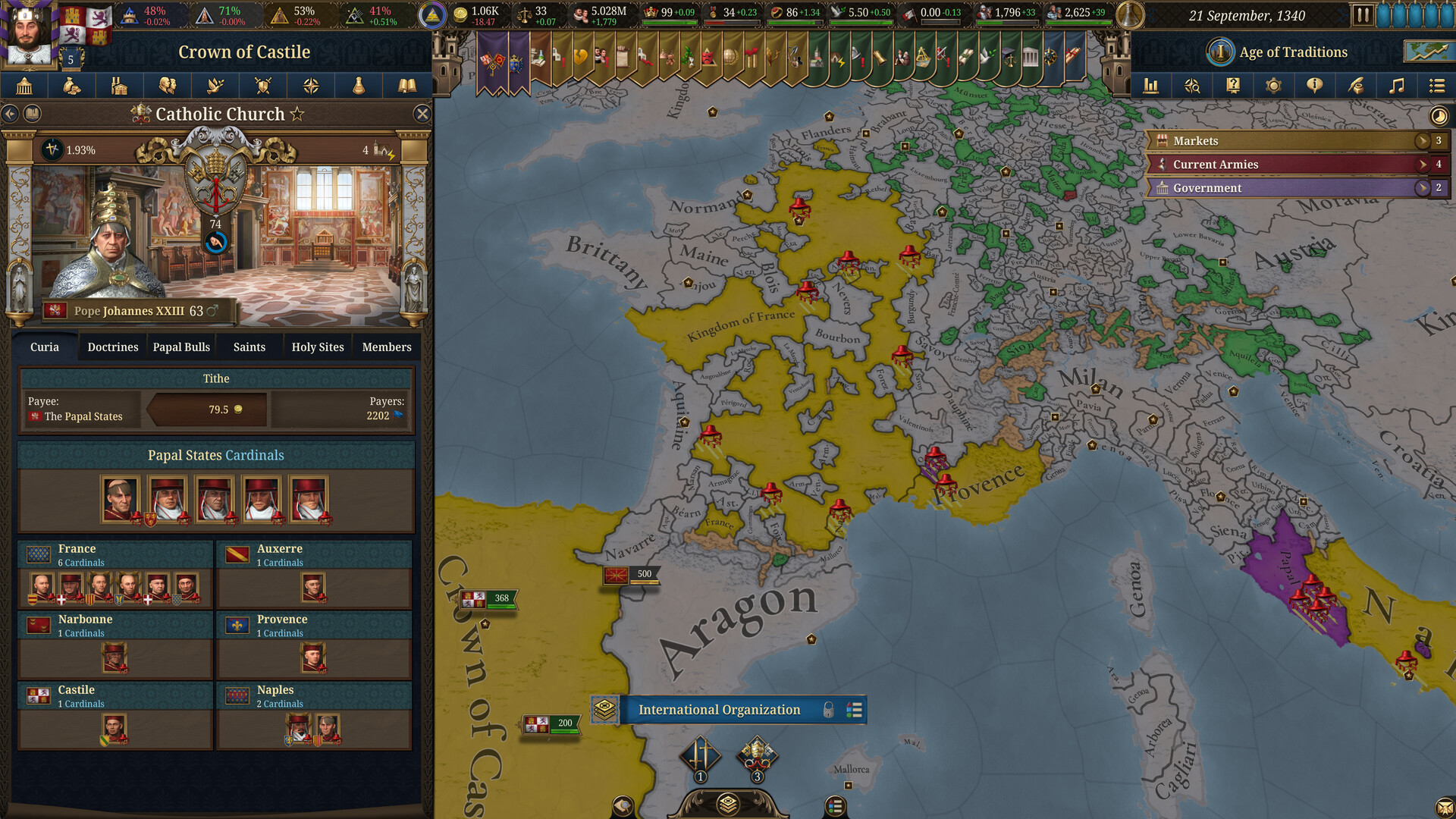
The September 23 diary, Tinto Talks 125, opens the confirmed Catholic rework of 1.4, and it is part one of a four-week arc hosted by Content Design Lead Pavía. Cardinals stop being a building and become named characters, Crusades and Jihads gain a defined leader and stakes, and a new Religious Orders mechanic places orders physically in provinces. Tinto Talks 127 then added Iberian and Maghrebi specific actions on top: Crusaders can Petition for the Bula de Cruzada, Summon the Iberian Military Orders, Launch a Cabalgada, or Demand Parias, while the Jihad side can Summon the Volunteers of the Faith, Cross the Strait, Proclaim the Ghazw, or Raid the Shores. Everything confirmed so far is in the dedicated Catholicism guide.
The Campaign Timeline, performance, and pacing
The September 9 diary, Tinto Talks 123, led with a genuinely free feature: the Campaign Timeline. It is free with 1.4 and explicitly not part of the Across the Pillars DLC. It lets you rewind to any point in a campaign and watch the map, one day at a time if you want, with nudge increments from a single day up to 50 years, a play button, and camera jump toggles for specific regions. At launch it also breaks down the primary stats, Population, Economic base, and Tax Base, sortable as pie charts or direct ranks. It lives in the Content Tab and in the top-right UI panel.
The same diary covered performance, and the headline is a pacing change with real consequences: hourly ticks are removed in 1.4. Ticks now run day to day, as they did in EU4, and Speeds 6 and 7 are gone, making speed 5 the maximum again. Removing the hourly tick adds roughly 10 to 15% faster performance on its own. Development also shared an internal observer-mode example, going from 2 minutes 45 seconds to reach January 1339 on 1.3 down to 47 seconds on the latest internal 1.4 build, on high-end hardware and with an honest caveat that exotic office stats should not be taken at face value for every system. The complacency system, the one that penalized growing too large, is removed completely in 1.4.
The same diary rounded out with a batch of balance and state-of-the-game items. An estate sitting above 25% power now puts a small drain on your legitimacy or its equivalent. Low government power is being rebalanced so that collapse hurts similarly across government types, with low devotion weighing harder on clergy and stability for Theocracies, and two new disasters, one for Theocracies and one for Republics, are confirmed as in the works. Theocracies, Steppe Hordes, and Tribes each get their own new capital flavor building. These items are confirmed but still being tuned, which is the normal state of a pre-beta build.
UI and quality of life
The UI pass is steady, practical stuff. The road builder gets a preview of the road before you build it, plus an option to skip sections where rivers or maritime connections already beat a road. Laws move to their own dedicated vertical panel, out of a cramped subtab. The country and throne-room panel is reorganized, a new Urbanization Panel takes over the old Production Locations screen, the budget panel gains a Tax Base Ratio stat, and a Turmoils Panel centralizes diseases, rebels, and movements in one place. Location building queues become visible and editable, up to six queue types. Two new map modes arrive, War Score and Crown Power, both per location. The Trade Orders UI overhaul is covered in the 1.4 economy guide.
Iberian and Maghrebi flavour content
The October 21 diary, Tinto Talks 128, surveyed the flavour content on both sides of the Strait of Gibraltar, and Pavía called it the biggest content addition to EU5 in a single update since release, with hundreds of advances, events, government reforms, estate privileges, policies, units, decisions, cabinet actions, town rights, and other assets added across the free 1.4 update and the paid DLC.
Castile gets a deep package built around what the team calls chained content: a Santa Hermandad chain that starts with a new Age of Renaissance advance, Hermandades Concejiles, which unlocks a decision in the Age of Discovery, which unlocks a government reform, which unlocks a light infantry unit, so the player can follow a visible progression of their own choices. Castile also gains a new law, Limpieza de Sangre, unlocked by the Torquemada event, plus new units, decisions (free and paid), and country interactions. Granada gets a solid flavour package of its own, and smaller Iberian countries are not skipped: Mallorca got a real content upgrade and even Andorra got some love.
Much of the flavour sits free in 1.4. Roughly 350 new advances go in for 48 countries and 8 culture tracks. In Iberia, advances for Castile, Aragon, Portugal, Navarra, and Granada are now split between country and culture ones, and minors including releaseable and formable tags such as Algarve, Toledo, Valencia, and Galicia get advances too, while all starting Iberian tags become reformable. There is also a pack of advances and flavour content for Jewish countries, and events built around the difficult coexistence of Christians, Muslims, and Sephardim in Late Medieval Iberia.
Morocco, the DLC’s other lead, gets its own layered package. A starting law for Morocco sets its stance toward the Tribesmen, its greatest strength and weakness at once. The whole Maghreb gets new town charters, culture-based units, and a naval package split half free and half DLC. Tunis gets an important content overhaul plus a starting puzzle to work out. On the free side, twenty-five Maghrebi countries, from Tunis and Tlemcen to Algeria, Kel Ahaggar, and Zab, receive new advances, alongside Algerian, Hassaniya, Moroccan, Tunisian, and Amazigh culture advances unlocking things like the Tuareg Veiled Cavalry, Andalusi Arquebusiers, and Barbary fusta naval levies.
One system deserves its own line: the Iberian Military Orders come in Across the Pillars as a unique religious order type for Iberian countries. They start with holdings across Iberia concentrated where they historically held land, and they begin with their historical grand masters, characters singled out as being built for war.
Across the Pillars: the paid DLC
The diary run, Tinto Talks 126 through 129 from September 30 to October 21, turns to the paid side: Across the Pillars, EU5’s first Chronicle Pack. A Chronicle Pack is a bigger beast than the earlier Fate of the Phoenix Immersion Pack, roughly double the content and built around a whole region rather than one country. The scope is the Late Medieval struggle for the Strait of Gibraltar, mostly inside the game’s first two ages (1337 to 1537), starring Castile and Marinid Morocco with Granada as the third party playing both sides.
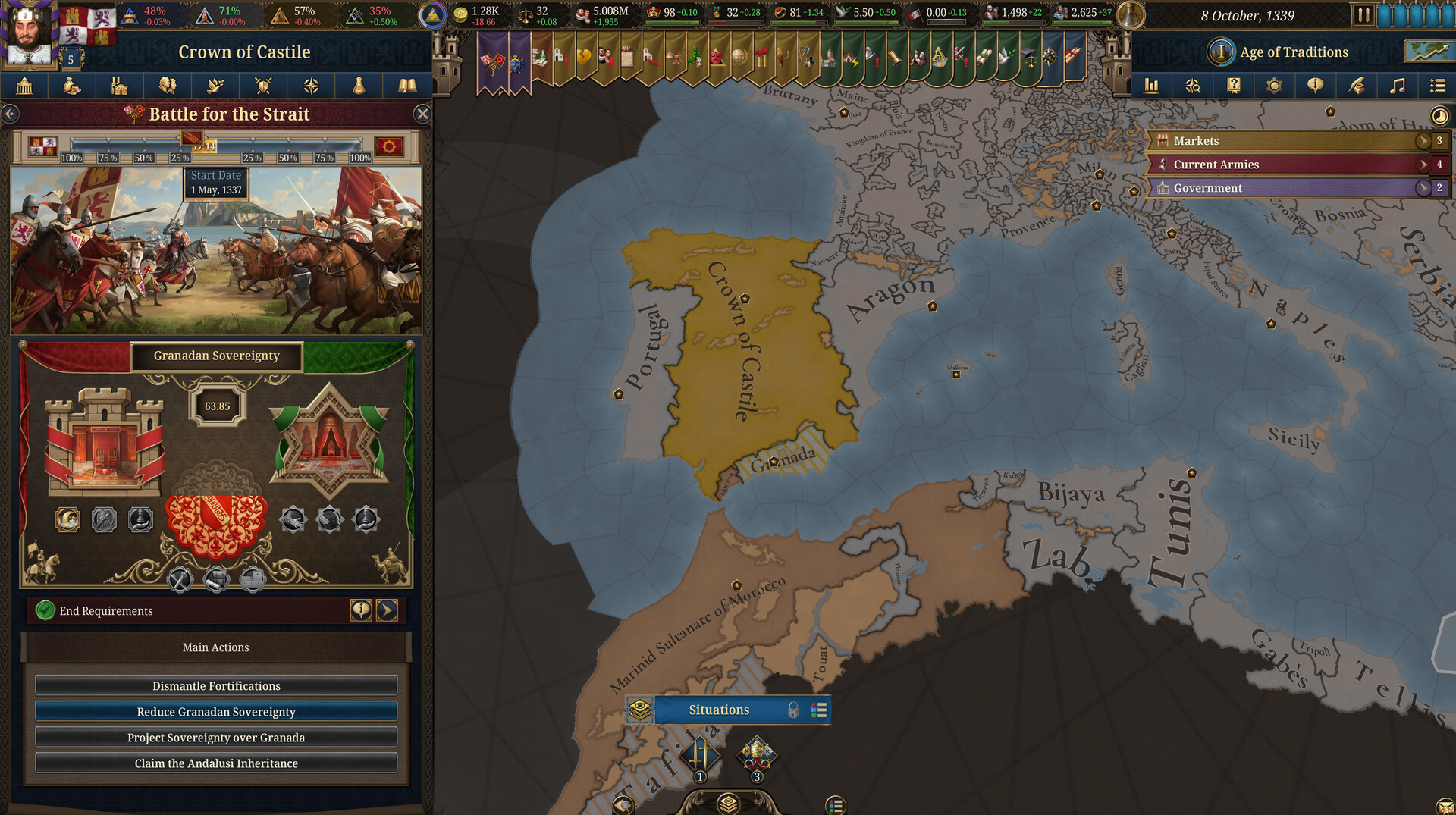
The DLC’s narrative spine is two new Situations. The Battle for the Strait portrays the run-up to the historical Castilian victory at Río Salado in 1340 and the conquest of Algeciras in 1344, fought over two axes: Influence over Granada, a tug-of-war between Castile and Morocco with shared and unique actions (4 for Castile, 6 for Morocco, 6 for Granada), and Granadan Sovereignty, Granada’s own path to winning the situation alone. Whoever wins gets the second Situation, the Golden Century, a mid-game challenge about projecting dominance abroad through Colonial Dominance and European Dominance axes, with mirrored versions for a Spanish or an Andalusi/Moroccan victor, a rival Grand Alliance international organization pushing back, and Flashpoint Events at key thresholds.
Mechanically, the DLC brings the Iberian Union back as EU5’s first unique Personal Union type, with two paths: rapid centralization toward an early Spain, or a decentralized composite monarchy. The base game also gets its Iberian Wedding event robusted so it fires more regularly for any eligible Iberian monarchy between 1400 and 1550. New bureaucracy sets arrive for Castile/Spain (modelled on the historical Councils), Granada and Morocco, Portugal, Navarre, plus eight generic Islamic bureaucracies that come free in the 1.4 base update. The 1.4 base game also gets a complete rework of the Itinerant Court mechanic.
Achievements, art, and music
The final diary before release, Tinto Talks 129 from October 21, rounds out the DLC with the traditional trio. The achievement list shown covers both the base 1.4 achievements and the Across the Pillars ones, with Steam’s new DLC-based achievement categories being tried out for the pack. The confirmed set includes Getting Things Strait (as Castile, have a cored city with a coastal fort on each side of the Strait of Gibraltar), Live Forever (enact the Masters of the Sahara decision), Re-Re-Reconquista (as Granada, form Al-Andalus and control the former Umayyad Caliphate of Córdoba territories), The Catalan Atlas (as Aragon, Mallorca, or Sicily, reunite the Aragonese Titular Holdings), The Last Crusade (as a Catholic country, lead a winning crusade in Northern Africa or the Middle East), The Road to El Dorado (discover El Dorado with an expedition), There and Back Again (complete the Circumnavigation of the Globe expedition), Tinto Monta (as Castile or Aragon, become the senior partner of the Iberian Union), Crossing the Pillars (as Castile, Morocco, or Granada, win both the Battle of the Strait and the Golden Century situations), Divide the Land (build a canal), Endured Atlas (as Morocco, secure a strong homeland and either centralize the government or keep strong support among the Tribesmen), and Family Matters (as Tunis, remove the Hafsid Familial Governor reform and leave no familial governor subjects).
On art, the DLC brings three headline pieces: a detailed loading screen of the Puerta de Indias in Seville around 1500 with Isabella and Ferdinand, Columbus reporting from the Americas, the Giralda and Torre del Oro behind them, and the motto Tanto Monta above the scene; a Moroccan army-on-the-march loading screen with red banners marked with golden crescents; and the key art of two leaders with blades locked, captioned as the heart of the DLC. There are 25+ new unit sprites and illustrations, including the Alabarderos, Castile’s royal guard who arrive through the conquistador mechanic rather than being recruited, a new Age 1 look for Castilian Knights used across Iberian cultures, the jinete-inspired Lanzas de Castilla cavalry, Morocco’s elite Black Guard slave soldiers, armored Heavy Camelry, Moroccan light ships built for speed, and heavier punching galleys. Unique character DNA comes for Iberian figures such as Pedro I, Enrique II, Gonzalo Fernández de Córdoba, Francisco Pizarro, Pedro González de Mendoza, and Francisco Jiménez de Cisneros, and Moroccan figures including Ibn Battuta, Ibn Khaldun, the Nasrid sultans, and Sidi Ahmed ou Moussa, with Castilian cultural outfits that signal rank through headwear and new Moroccan portraits. Monuments add five for Morocco, the Alhambra, Rock of Gibraltar, Qarawiyyin, Kutubiyya, and Ksar Aït Benhaddou, and three for Castile, the Alcázar de Segovia, the Mosque/Cathedral of Córdoba, and the Cathedral of Santiago de Compostela.
The pack closes with 9 unique musical tracks joining EU5’s dynamic music, with period Castilian performances by Ensemble Altamar and a Moroccan soundtrack created with Asmâa Hamzaoui, a master of the Gnawa spiritual musical tradition. The Across the Pillars OST releases October 24 on Spotify, Apple Music, and the EU5 YouTube channel. There is no Tinto Talk next Wednesday: October 28 is release day.
What is still coming
The preview run is over. Everything the diaries teased has now arrived: the four-week Catholicism arc concluded with Tinto Talks 128 and 129 covering flavour content, achievements, art, and music, and there is no further diary before launch. Update 1.4 Río Salado and the Across the Pillars Chronicle Pack release October 28, 2026, and this page will shift from preview tracking to reflecting the live release once the build is out and its numbers are verifiable. Update 1.5 Fealty and the 2.0 Discovery Update are announced but undated, and this hub stays a 1.4 document: 1.5 diaries, when they start, will get their own coverage.